
|
You entered: magnetic field
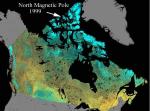 Earth's North Magnetic Pole
19.10.1999
A magnetic compass does not point toward the true North Pole of the Earth. Rather, it more closely points toward the North Magnetic Pole of the Earth. The North Magnetic Pole is currently located in northern Canada.
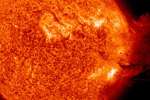 The Sun Unleashed
10.06.2011
On June 7, the Sun unleashed only a medium sized solar flare as rotation carried active regions of sunpots toward the solar limb. But that flare was followed by an astounding gush of magnetized plasma seen erupting at the Sun's edge in this extreme ultraviolet image from the Solar Dynamics Observatory.
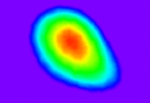 Painting with Solar Neutrons
25.10.1995
Solar flares are propelled high above the Sun's surface by powerful, twisted magnetic fields. The flares spew high energy atomic and subatomic particles into space. During an intense solar flare on June 15, 1991, a spray of solar neutrons was detected by the COMPTEL instrument onboard NASA's Compton Gamma Ray Observatory.
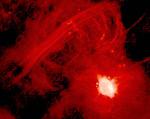 The Galactic Center Radio Arc
3.04.2005
What causes this unusual structure near the center of our Galaxy? The long parallel rays slanting across the top of the above radio image are known collectively as the Galactic Center Radio Arc and jut straight out from the Galactic plane.
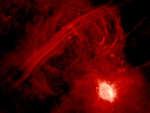 The Galactic Center Radio Arc
27.04.2008
What causes this unusual structure near the center of our Galaxy? The long parallel rays slanting across the top of the above radio image are known collectively as the Galactic Center Radio Arc and jut straight out from the Galactic plane.
 APOD: 2024 January 14 Б Dragon Aurora over Iceland
14.01.2024
Have you ever seen a dragon in the sky? Although real flying dragons don't exist, a huge dragon-shaped aurora developed in the sky over Iceland in 2019. The aurora was caused...
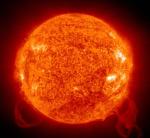 Double Eruptive Prominences
18.04.2003
Lofted over the Sun on looping magnetic fields, large solar prominences are composed of relatively cool, dense plasma. When seen against the brilliant solar disk they appear as dark filaments, but these enormous magnetic...
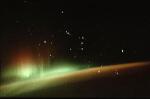 Aurora and Orion
26.01.1997
Looking toward the south from low Earth orbit, the crew of the Space Shuttle Endeavor made this stunning time exposure of the Aurora Australis or southern lights in April of 1994. Aurora are visible at high northern latitudes as well, with the northern lights known as Aurora Borealis.
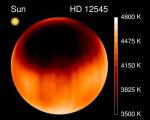 A Giant Starspot on HD 12545
2.11.2003
What could cause a star to have such a large spot? Our Sun itself frequently has sunspots, relatively cool dark magnetic depressions that move across its surface. HD 12545, however, exhibits the largest starspots yet observed.
 Movie: The Active Sun
4.12.2006
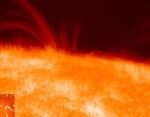
Plumes of hot gas shoot across the surface on even an average day on the Sun. Such volatile activity was captured in dramatic detail recently by the new Hinode satellite launched by Japan in late September.
|
January February March April May June July August September October |
|||||||||||||||||||||||||||||||||||||||||||||||||