
|
You entered: ionization region
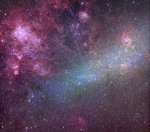 The Large Cloud of Magellan
16.10.2010
The 16th century Portuguese navigator Ferdinand Magellan and his crew had plenty of time to study the southern sky during the first circumnavigation of planet Earth. As a result, two fuzzy cloud-like objects easily...
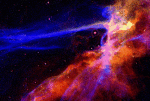 Rampaging Fronts of the Veil Nebula
7.03.1996
A supernova explosion of a high-mass star results in fast moving blast waves. At the front of the waves shown above, ionized gas in the Veil Supernova Remnant rushes out from the explosion, sweeps up material, and breaks up many atoms into constituent ions and electrons.
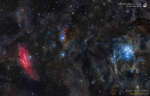 From California to the Pleiades
22.11.2013
An astronomical trip from the California Nebula to the Pleiades star cluster would cover just 12 degrees across planet Earth's night sky. That's equivalent to the angular extent of 25 Full Moons, as your telescope sweeps over the borders of the constellations Perseus and Taurus.
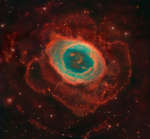 M57: The Ring Nebula
20.04.2012
Except for the rings of Saturn, the Ring Nebula (M57) is probably the most famous celestial band. Its classic appearance is understood to be due to perspective - our view from planet Earth looks down the center of a roughly barrel-shaped cloud of glowing gas.
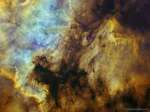 The North America and Pelican Nebulas
14.06.2016
Here lie familiar shapes in unfamiliar locations. On the left is an emission nebula cataloged as NGC 7000, famous partly because it resembles our fair planet's continent of North America. The emission region to the right of the North America Nebula is IC 5070, also known for its suggestive outlines as the Pelican Nebula.
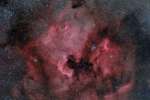 North America and the Pelican
3.09.2013
Here lie familiar shapes in unfamiliar locations. On the left is an emission nebula cataloged as NGC 7000, famous partly because it resembles our fair planet's continent of North America. The emission region to the right of the North America Nebula is IC 5070, also known for its suggestive outlines as the Pelican Nebula.
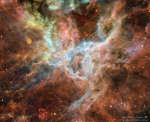 In the Heart of the Tarantula Nebula
20.05.2018
In the heart of monstrous Tarantula Nebula lies huge bubbles of energetic gas, long filaments of dark dust, and unusually massive stars. In the center of this heart, is a knot of stars so dense that it was once thought to be a single star.
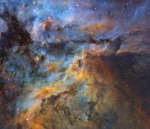 South of Carina
22.05.2020
With natal dust clouds in silhouette against glowing atomic gas, this colorful and chaotic vista lies within one of the largest star forming regions in the Milky Way galaxy, the Great Carina Nebula.
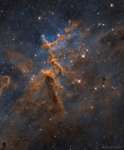 Melotte 15 inthe Heart
10.02.2017
Cosmic clouds form fantastic shapes in the central regions of emission nebula IC 1805. The clouds are sculpted by stellar winds and radiation from massive hot stars in the nebula's newborn star cluster, Melotte 15.
 APOD: 2024 September 17 Б Melotte 15 in the Heart Nebula
17.09.2024
Cosmic clouds form fantastic shapes in the central regions of emission nebula IC 1805. The clouds are sculpted by stellar winds and radiation from massive hot stars in the nebula's newborn star cluster, Melotte 15.
|
January February March April May June July August September |
|||||||||||||||||||||||||||||||||||||||||||||||||