
|
You entered: Coma
 APOD: 2025 June 30 Б NGC 4651: The Umbrella Galaxy
30.06.2025
It's raining stars. What appears to be a giant cosmic umbrella is now known to be a tidal stream of stars stripped from a small satellite galaxy. The main galaxy, spiral galaxy...
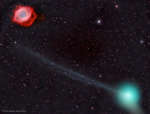 Comet PanSTARRS and the Helix Nebula
5.06.2016
It's rare that such different objects are imaged so close together. Such an occasion is occurring now, though, and was captured two days ago in combined parallel exposures from the Canary Islands of Spain.
 Periodic Comet Swift Tuttle
8.08.2024
A Halley-type comet with an orbital period of about 133 years, Comet 109P/Swift-Tuttle is recognized as the parent of the annual Perseid Meteor Shower. The comet's last visit to the inner Solar System was in 1992.
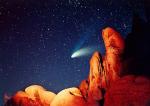 A Farewell to Tails
15.12.1997
As 1997 fades, so does the Great Comet of 1997: Comet Hale-Bopp. Discovered even before the Great Comet of 1996, Comet Hale-Bopp became the brightest comet since 1976. Many will remember Comet Hale-Bopp as a comet with a coma so bright it could be seen by eye even when near the Moon.
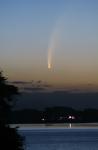 Southern Comet
18.01.2007
After a remarkable performance in the northern hemisphere, the brightest comet in decades is now showing off in the south. Recorded during evening twilight on January 17, this view features the bright coma...
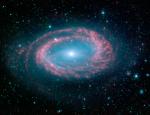 One Armed Spiral Galaxy NGC 4725
1.09.2005
While most spiral galaxies, including our own Milky Way, have two or more spiral arms, peculiar galaxy NGC 4725 has only one. In this false-color Spitzer Space Telescope infrared image, the galaxy's solo spira mirabilis is seen in red, highlighting the emission from dust clouds warmed by newborn stars.
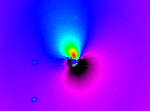 A Dust Jet From Hale-Bopp
29.07.1996
Approaching the inner Solar System, comet Hale-Bopp's icy nucleus is heated by sunlight, accelerating its production of dust and gas. Shrouded in the resulting cloud, known as the coma, the cometary nucleus remains hidden from direct view.
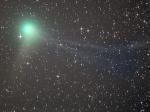 Announcing Comet Machholz
13.12.2004
A comet discovered only this summer is brightening quickly and already visible to the unaided eye. Comet C/2004 Q2 (Machholz) is currently best visible in Earth's Southern Hemisphere where some observers report it brighter than magnitude 5. The comet is moving rapidly to northern skies and should continue to brighten until early January.
 APOD: 2024 November 11 Б The Unusual Tails of Comet Tsuchinshan Atlas
11.11.2024
What created an unusual dark streak in Comet Tsuchinshan-Atlas's tail? Some images of the bright comet during mid-October not only caught its impressively long tail and its thin anti-tail, but a rather unexpected feature: a dark streak in the long tail.
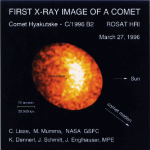 Unexpected X-rays from Comet Hyakutake
11.04.1996
The first X-rays ever detected from a comet were discovered from Comet Hyakutake with the ROSAT satellite on March 27th. The discovery is particularly surprising because there was little previous indication that comets emit any significant X-radiation.
|
January February |
|||||||||||||||||||||||||||||||||||||||||||||||||