
|
You entered: star
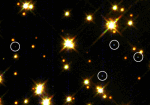 White Dwarfs Cool
10.09.1995
The circled stars in the above picture are from a class that is hard to see in the cosmos: white dwarfs. The entire photo covers a small region near the center of a globular cluster known as M4. Researchers using the Hubble Space Telescope discovered a large concentration of white dwarfs in M4.
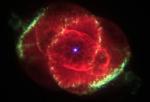 The Cat's Eye Nebula
2.08.1997
Three thousand light years away, a dying star throws off shells of glowing gas. This image from the Hubble Space Telescope reveals "The Cat's Eye Nebula" to be one of the most complex planetary nebulae known.
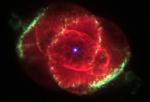 The Cat's Eye Nebula
1.11.1998
Three thousand light years away, a dying star throws off shells of glowing gas. This image from the Hubble Space Telescope reveals The Cat's Eye Nebula to be one of the most complex planetary nebulae known.
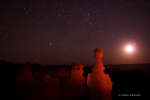 Hoodoo Sky
3.07.2008
The strange-looking rock formations in the foreground of this skyscape are called hoodoos. Towers of weathered, eroded sedimentary rock, hoodoos are found in arid regions of planet Earth and are particularly abundant in an area known as Bryce Canyon National Park in southern Utah, USA.
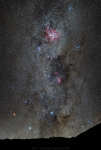 The Southern Cross in a Southern Sky
19.10.2015
Have you ever seen the Southern Cross? This famous constellation is best seen from Earth's Southern Hemisphere. Captured from Rio de Janeiro, Brazil, the four bright stars that mark the Southern Cross are visible just above the horizon in the featured image.
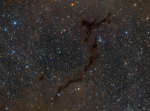 Barnard 150: Seahorse in Cepheus
25.10.2018
Light-years across, this suggestive shape known as the Seahorse Nebula appears in silhouette against a rich, luminous background of stars. Seen toward the royal northern constellation of Cepheus, the dusty, obscuring clouds are part of a Milky Way molecular cloud some 1,200 light-years distant.
 The Dark Seahorse of Cepheus
19.09.2024
Spanning light-years, this suggestive shape known as the Seahorse Nebula floats in silhouette against a rich, luminous background of stars. Seen toward the royal northern constellation of Cepheus, the dusty, dark nebula is part of a Milky Way molecular cloud some 1,200 light-years distant.
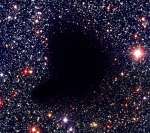 Molecular Cloud Barnard 68
13.12.2014
Where did all the stars go? What used to be considered a hole in the sky is now known to astronomers as a dark molecular cloud. Here, a high concentration of dust and molecular gas absorb practically all the visible light emitted from background stars.
 APOD: 2023 April 9 Б The Egg Nebula in Polarized Light
9.04.2023
Where is the center of the Egg Nebula? Emerging from a cosmic egg, the star in the center of the Egg Nebula is casting away shells of gas and dust as it slowly transforms itself into a white dwarf star. The Egg Nebula is a rapidly evolving pre- planetary nebula spanning about one light year.
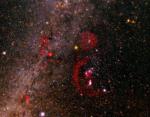 Canaries Sky
5.03.1998
This gorgeous view of stars, nebulae, and the Milky Way comes from the dark night sky above the lovely island of La Palma in the Canaries archipelago. The picture was made by a group...
|
January February March April May June July August September |
|||||||||||||||||||||||||||||||||||||||||||||||||