
|
You entered: Earth orbit
 Mizar Binary Star
18.02.1997
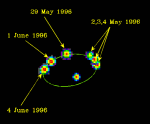
Mizar (sounds like "My Czar") is a binary star. In fact, most stars are binary stars. In a binary star system, each star of the pair follows an elliptical orbital path. Mutual gravity causes...
 APOD: 2007 February 20- White Ridges on Mars
19.02.2007
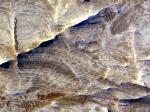
What created these white ridges on Mars? The images showing the white ridges, including some of the highest resolution images ever taken from Martian orbit, were recorded last year by the Mars Reconnaissance Orbiter (MRO).
 The Cosmic Web of the Tarantula Nebula
10.01.2011
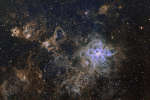
It is the largest and most complex star forming region in the entire galactic neighborhood. Located in the Large Magellanic Cloud, a small satellite galaxy orbiting our Milky Way galaxy, the region's spidery appearance is responsible for its popular name, the Tarantula nebula. This tarantula, however, is about 1,000 light-years across.
 The Cosmic Web of the Tarantula Nebula
17.02.2014
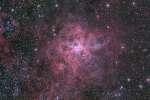
It is the largest and most complex star forming region in the entire galactic neighborhood. Located in the Large Magellanic Cloud, a small satellite galaxy orbiting our Milky Way galaxy, the region's spidery appearance is responsible for its popular name, the Tarantula nebula. This tarantula, however, is about 1,000 light-years across.
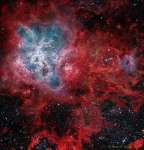 The Cosmic Web of the Tarantula Nebula
7.11.2016
It is the largest and most complex star forming region in the entire galactic neighborhood. Located in the Large Magellanic Cloud, a small satellite galaxy orbiting our Milky Way galaxy, the region's spidery appearance is responsible for its popular name, the Tarantula nebula. This tarantula, however, is about 1,000 light-years across.
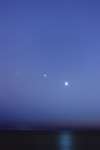 Conjunctions near Dawn
30.06.2012
Now shining in eastern skies at dawn, bright planets Venus and Jupiter join the Pleiades star cluster in this sea and sky scape, recorded earlier this week near Buenos Aires, Argentina. Venus dominates the scene that includes bright star Aldebaran just below and to the right.
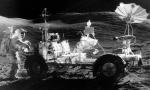 Apollo 17's Lunar Rover
1.07.1999
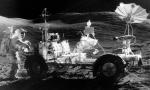
In December of 1972, Apollo 17 astronauts Eugene Cernan and Harrison Schmitt spent about 75 hours exploring the Moon's Taurus-Littrow valley while colleague Ronald Evans orbited overhead. Cernan and Schmitt were the last humans to walk or ride on the Moon - aided in their explorations by a Lunar Roving Vehicle.
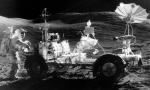 Apollo 17 s Lunar Rover
5.06.2004
In December of 1972, Apollo 17 astronauts Eugene Cernan and Harrison Schmitt spent about 75 hours exploring the Moon's Taurus-Littrow valley while colleague Ronald Evans orbited overhead. Cernan and Schmitt were the last humans to walk or ride on the Moon - aided in their explorations by a Lunar Roving Vehicle.
 Apollo 17 s Lunar Rover
9.06.2001
In December of 1972, Apollo 17 astronauts Eugene Cernan and Harrison Schmitt spent about 75 hours exploring the Moon's Taurus-Littrow valley while colleague Ronald Evans orbited overhead. Cernan and Schmitt were the last humans to walk or ride on the Moon - aided in their explorations by a Lunar Roving Vehicle.
 Ski Enceladus
23.02.2005
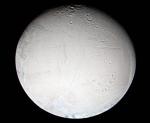
Small, icy, inner moon of Saturn, Enceladus is only about 500 kilometers in diameter. But the distant world does reflect over 90 percent of the sunlight it receives, giving its surface about the same reflectivity as fresh snow.
|
January February March April May June July August September October |
|||||||||||||||||||||||||||||||||||||||||||||||||