
|
You entered: spacecraft
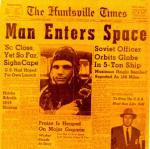 Man Enters Space
14.04.2001
Forty years ago, on April 12, 1961, Soviet cosmonaut Yuri Alexseyevich Gagarin became the first human in space. His remotely controlled Vostok 1 spacecraft lofted him to an altitude of 200 miles and carried him once around planet Earth. Gagarin was strictly a passenger on this flight.
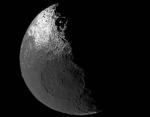 Dark Terrain on Saturn s Iapetus
3.01.2006
Why are vast sections of Iapetus as dark as coal? No one knows for sure. Iapetus, the third largest moon of Saturn, was inspected again as the Saturn-orbiting robot Cassini spacecraft swooped past the enigmatic world again late last year.
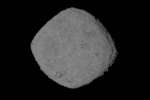 Rotating Asteroid Bennu from OSIRIS REx
13.11.2018
Could this close-by asteroid ever hit the Earth? Eventually yes -- but probably not for a very long time, even though the asteroid is expected to pass inside the orbit of the Moon next century.
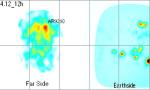 Far Side of the Sun
3.05.2001
You may think it's impossible to see through the Sun, but maps of the Sun's far side are now made routinely by instruments on board the sun-staring SOHO spacecraft. This is one such map from April 12.
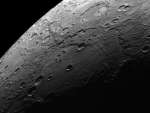 Rembrandt Impact Basin on Mercury
4.05.2009
Why do portions of this huge crater on Mercury have so much iron? The unusual Rembrandt impact basin was discovered recently in images taken during the robotic MESSENGER spacecraft's 2008 October flyby of the Solar System's innermost planet.
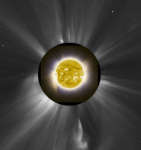 An Active Sun During a Total Eclipse
11.11.2013
Sometimes, a total eclipse of the Sun is an opportunity. Taking advantage of such, the above image shows the solar eclipse earlier this month as covered and uncovered by several different solar observatories.
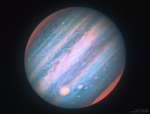 Jupiter in Infrared from Hubble
21.02.2018
Jupiter looks a bit different in infrared light. To better understand Jupiter's cloud motions and to help NASA's robotic Juno spacecraft understand the Hubble Space Telescope is being directed to regularly image the entire Jovian giant.
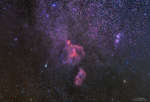 Comet Heart and Soul
23.08.2018
The greenish coma of comet 21P/Giacobini-Zinner stands out at the left of this telephoto skyscape spanning over 10 degrees toward the northern constellations Cassiopeia and Perseus. Captured on August 17, the periodic comet is the known parent body of the upcoming Draconid meteor shower.
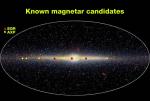 Magnetars In The Sky
26.11.2004
Indicated on this infrared image of the galactic center region are positions of candidate magnetars -- believed to be the strongest magnets in the galaxy. Classified by observers as Soft Gamma Repeaters (SGRs) and Anomalous X-ray Pulsars (AXPs), these cosmic powerhouses are likely city-sized, spinning, highly-magnetized neutron stars. How strong is a magnetar's magnetic field?
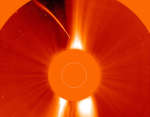 Sungrazer
27.10.2013
Arcing toward a fiery fate, this Sungrazer comet was recorded by the SOHO spacecraft's Large Angle Spectrometric COronagraph(LASCO) on December 23, 1996. LASCO uses an occulting disk, partially visible at the lower...
|
January February March April May June July August September |
|||||||||||||||||||||||||||||||||||||||||||||||||