
|
You entered: nearest stars
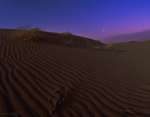 Brighter Than Mars
27.08.2010
Even though you may have just read an email claiming Mars will be incredibly bright tonight, the brightest star on the horizon is not Mars. From central Iran on August 24th, the brightest star in this twilight desert skyview is Venus, aka the Evening Star.
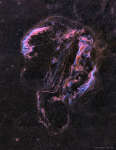 The Ghostly Veil Nebula
31.10.2019
A ghostly visage on a cosmic scale, these remains of shocked, glowing gas haunt planet Earth's sky toward the constellation of Cygnus and form the Veil Nebula. The nebula itself is a large supernova remnant, an expanding cloud born of the death explosion of a massive star.
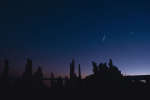 Leonid over Mono Lake
19.11.2009
Eerie spires of rock rise from shore of Mono Lake in the foreground of this early morning skyscape. The salty, mineral-laden lake is located in California's eastern Sierra Nevada mountain range and the spindly rock formations are naturally formed limestone towers called tufa.
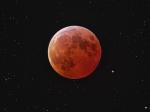 Eclipsed Moon and Stars
8.03.2007
This dramatic image features a dark red Moon during a total lunar eclipse -- celestial shadow play enjoyed by many denizens of planet Earth last Saturday. Recorded near Wildon, Austria, the picture is a composite...
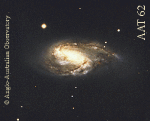 Unusual Spiral Galaxy M66
10.08.1996
Spiral galaxy M66 is largest galaxy in the a group known as the Leo Triplet. M66 is somewhat peculiar because of its asymmetric spiral arms. Usually dense waves of gas, dust, and newly formed stars - called spiral density waves - circle a galactic center and create a symmetric galaxy.
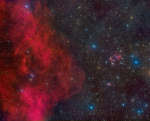 Barnard Stares at NGC 2170
19.01.2013
A gaze across a cosmic skyscape, this telescopic mosaic reveals the continuous beauty of things that are. The evocative scene spans some 6 degrees or 12 Full Moons in planet Earth's sky. At the left, folds of red, glowing gas are a small part of an immense, 300 light-year wide arc.
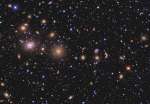 Galaxies of the Perseus Cluster
8.05.2009
This colorful telescopic skyscape is filled with galaxies that lie nearly 250 million light-years away, the galaxies of the Perseus cluster. Their extended and sometimes surprising shapes are seen beyond a veil of foreground stars in our own Milky Way.
 Comet and Orion
2.10.2009
These colorful panels both feature a familiar northern hemisphere astronomical sight: the stellar nursery known as the Great Orion Nebula. They also offer an intriguing and unfamiliar detail of the nebula rich skyscape -- a passing comet.
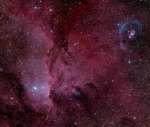 NGC 6188 and NGC 6164
28.07.2011
Fantastic shapes lurk in clouds of glowing hydrogen gas in NGC 6188. The emission nebula is found near the edge of a large molecular cloud, unseen at visible wavelengths, in the southern constellation Ara, about 4,000 light-years away.
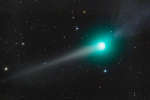 Two Tails of Comet Lulin
25.02.2009
Go outside tonight and see Comet Lulin. From a dark location, you should need only a good star map and admirable perseverance -- although wide-field binoculars might help. Yesterday, Comet Lulin passed its closest to Earth, so that the comet will remain near its brightest over the next few days.
|
January February March April May June July August September October |
|||||||||||||||||||||||||||||||||||||||||||||||||