
|
You entered: Earth orbit
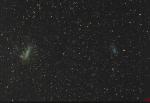 A Magellanic Mural
3.02.1998
Two galaxies stand out to casual observers in Earth's Southern Hemisphere: the Large Magellanic Cloud (LMC) and the Small Magellanic Cloud (SMC). These irregular galaxies are two of the closest galaxies to our Milky Way Galaxy.
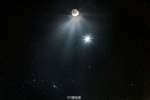 Comet Meets Moon and Morning Star
12.12.2015
A crescent Moon and brilliant Venus met in predawn skies on December 7, a beautiful conjunction of planet Earth's two brightest celestial beacons after the Sun. Harder to see but also on the scene was Comet Catalina (C/2013 US10).
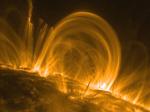 Heating Coronal Loops
14.08.2005
Why is the corona of the Sun so hot? Extending above the photosphere or visible surface of the Sun, the faint, tenuous solar corona can't be easily seen from Earth, but it is measured to be hundreds of times hotter than the photosphere itself.
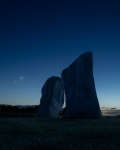 APOD: 2026 June 12 Б Venus and Jupiter: Conjunction from Avebury
12.06.2026
To see Venus and Jupiter together this month, you won't need binoculars or even a telescope. Just look up after sunset and you'll find them emerging as the sky grows dark near the western horizon.
 Apollo 17's Moonship
6.01.2001
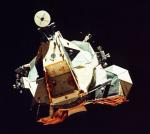
Awkward and angular looking, Apollo 17's lunar module Challenger was designed for flight in the vacuum of space. This sharp picture from the command module America, shows Challenger's ascent stage in lunar orbit.
 X Ray Portrait of Trumpler 14
2.09.2005
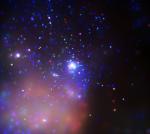
A wonder of planet Earth's southern sky, star cluster Trumpler 14 lies about nine thousand light-years away in the Carina complex -- a rich star forming region at the edge of a giant molecular cloud.
 Gibbous Europa
8.03.2009
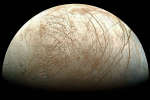
Although the phase of this moon might appear familiar, the moon itself might not. In fact, this gibbous phase shows part of Jupiter's moon Europa. The robot spacecraft Galileo captured this image mosaic during its mission orbiting Jupiter from 1995 - 2003.
 Gibbous Europa
30.01.2011
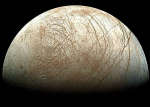
Although the phase of this moon might appear familiar, the moon itself might not. In fact, this gibbous phase shows part of Jupiter's moon Europa. The robot spacecraft Galileo captured this image mosaic during its mission orbiting Jupiter from 1995 - 2003.
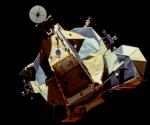 Apollo 17 s Moonship
7.01.2006
Awkward and angular looking, Apollo 17's lunar module Challenger was designed for flight in the vacuum of space. This picture from command module America, shows Challenger's ascent stage in lunar orbit. Small reaction control thrusters are at the sides of the moonship with the bell of the ascent rocket engine underneath.
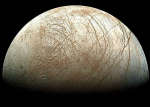 Gibbous Europa
15.12.2013
Although the phase of this moon might appear familiar, the moon itself might not. In fact, this gibbous phase shows part of Jupiter's moon Europa. The robot spacecraft Galileo captured this image mosaic during its mission orbiting Jupiter from 1995 - 2003.
|
January February March April May June July August September October |
|||||||||||||||||||||||||||||||||||||||||||||||||