
|
You entered: rings
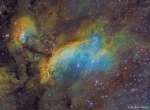 IC 4628: The Prawn Nebula
4.07.2016
South of Antares, in the tail of the nebula-rich constellation Scorpius, lies emission nebula IC 4628. Nearby hot, massive stars, millions of years young, radiate the nebula with invisible ultraviolet light, stripping electrons from atoms. The electrons eventually recombine with the atoms to produce the visible nebular glow, dominated by the red emission of hydrogen.
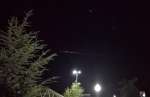 A Rocket Booster Falls Back to Earth
2.08.2016
What's that crossing the sky? Although it looked a bit like a large meteor, it was actually the booster of a Chinese rocket returning to Earth after its launch two days earlier.
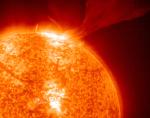 A Solar Prominence Erupts
24.09.2001
Our Sun is still very active. Last year, our Sun went though Solar Maximum, the time in its 11-year cycle where the most sunspots and explosive activities occur. Sunspots, the Solar Cycle, and solar prominences are all caused by the Sun's changing magnetic field.
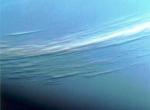 Two Hours Before Neptune
22.09.2002
Two hours before closest approach to Neptune in 1989, the Voyager 2 robot spacecraft snapped this picture. Clearly visible for the first time were long light-colored cirrus-type clouds floating high in Neptune's atmosphere. Shadows of these clouds can even be seen on lower cloud decks.
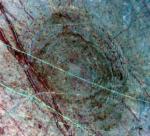 Impact on Europa
15.08.1997
This bull's-eye pattern marks the impact of a mountain-sized comet or asteroid on the icy surface of Jupiter's moon Europa. Recorded by the Galileo spacecraft in April of this year, the composite false color image clearly reveals the telltale concentric fractures which cover about
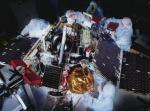 Invader From Earth
8.01.1999
These technicians are working on the solar-paneled Mars Polar Lander - yet another robotic spacecraft scheduled to invade the red planet. Mars Polar Lander is part of a series of missions focusing on a search for evidence of past or present life.
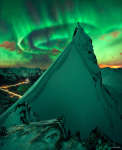 In Green Company: Aurora over Norway
9.11.2020
Raise your arms if you see an aurora. With those instructions, two nights went by with, well, clouds -- mostly. On the third night of returning to same peaks, though, the sky not only cleared up but lit up with a spectacular auroral display.
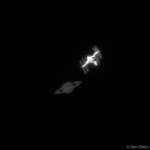 Saturn and ISS
9.07.2022
Soaring high in skies around planet Earth, bright planet Saturn was a star of June's morning planet parade. But very briefly on June 24 it posed with a bright object in low Earth orbit, the International Space Station.
 The Mysterious Cone Nebula
7.01.2002
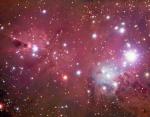
Sometimes the simplest shapes are the hardest to explain. For example, the origin of the mysterious cone-shaped region seen on the far left remains a mystery. The interstellar formation, dubbed the Cone Nebula, is located about 2700 light years away.
 Stellar Laboratories in the LMC
25.07.1997
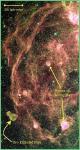
Stars are evolving in the Large Magellanic Clouds (LMC). This is particularly evident in the above close-up of the LMC's edge, which appears about as large as the full moon. Visible only...
|
January February |
|||||||||||||||||||||||||||||||||||||||||||||||||