
|
You entered: Earth orbit
 APOD: 2023 May 31 Б Simulation: A Disk Galaxy Forms
31.05.2023
How did we get here? We know that we live on a planet orbiting a star orbiting a galaxy, but how did all of this form? Since our universe moves too slowly to watch, faster-moving computer simulations are created to help find out.
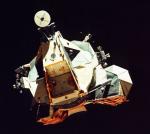 Apollo 17s Moonship
15.04.1999
Awkward and angular looking, Apollo 17's lunar module Challenger was designed for flight in the vacuum of space. This sharp picture from the command module America, shows Challenger's ascent stage in lunar orbit.
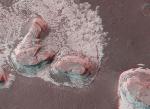 3D Mars: Northern Terra Meridiani
28.08.2002
In this spectacular 3D stereoscopic view from orbit, steep-sided, flat-topped hills stand above the Terra Meridiani region of Mars. Seen best with red/blue glasses (red for the left eye), the structures are reminiscent of buttes and mesas found in southwestern areas of the North American continent on planet Earth.
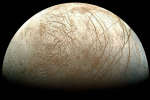 Gibbous Europa
2.12.2007
Although the phase of this moon might appear familiar, the moon itself might not. In fact, this gibbous phase shows part of Jupiter's moon Europa. The robot spacecraft Galileo captured this image mosaic during its mission orbiting Jupiter from 1995 - 2003.
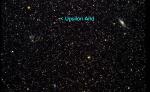 Where is Upsilon Andromedae
22.04.1999
Astronomers recently announced the detection of three large planets orbiting the star Upsilon Andromedae - the first planetary system known to orbit a normal star other than our Sun. These planets were not directly photographed but found through a Doppler technique developed to use large telescopes to search nearby stars for wobbling planetary signatures.
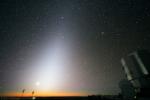 Zodiacal Light and the False Dawn
25.09.2007
An unusual triangle of light will be particularly bright near the eastern horizon before sunrise during the next two months for observers in Earth's northern hemisphere. Once considered a false dawn, this triangle of light is actually Zodiacal Light, light reflected from interplanetary dust particles.
 APOD: 2025 February 5 Б Comet G3 ATLAS Setting over a Chilean Hill
5.02.2025
Where is Comet ATLAS going? In the featured time-lapse video, the comet is not itself moving very much, but the Earth's rotation makes it appear to be setting over a hill. The Comet C/2024 G3 (ATLAS) sequence was captured with an ordinary camera on January 22 from the Araucanцa Region in central Chile.
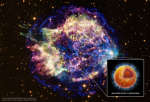 Cooling Neutron Star
1.05.2017
The bright source near the center is a neutron star, the incredibly dense, collapsed remains of a massive stellar core. Surrounding it is supernova remnant Cassiopeia A (Cas A), a comfortable 11,000 light-years away. Light from the Cas A supernova, the death explosion of a massive star, first reached Earth about 350 years ago.
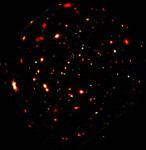 The Cosmic X-Ray Background
9.11.2000
Early on, x-ray satellites revealed a surprising cosmic background glow of x-rays and astronomers have struggled to understand its origin. Now, peering through a hole in the obscuring gas and dust...
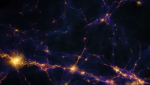 Galaxy Formation in a Magnetic Universe
19.02.2018
How did we get here? We know that we live on a planet orbiting a star orbiting a galaxy, but how did all of this form? To understand details better, astrophysicists upgraded the famous Illustris Simulation into IllustrisTNG -- now the most sophisticated computer model of how galaxies evolved in our universe.
|
January February March April May June July August September October |
|||||||||||||||||||||||||||||||||||||||||||||||||