
|
You entered: star cluster
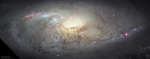 M106 Close Up
3.05.2012
Close to the Great Bear (Ursa Major) and surrounded by the stars of the Hunting Dogs (Canes Venatici), this celestial wonder was discovered in 1781 by the metric French astronomer Pierre Mechain. Later, it was added to the catalog of his friend and colleague Charles Messier as M106.
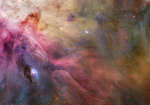 LL Ori and the Orion Nebula
3.02.2013
This esthetic close-up of cosmic clouds and stellar winds features LL Orionis, interacting with the Orion Nebula flow. Adrift in Orion's stellar nursery and still in its formative years, variable star LL Orionis produces a wind more energetic than the wind from our own middle-aged Sun.
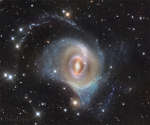 APOD: 2026 February 4 Б Spiral Galaxy NGC 1512: Wide Field
4.02.2026
Most galaxies don't have any rings -- why does this galaxy have three? To begin, a ring that's near NGC 1512's center -- and so hard to see here -- is the nuclear ring which glows brightly with recently formed stars.
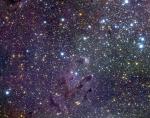 M16: Stars, Pillars and the Eagle s EGGs
3.01.2002
The Hubble Space Telescope's 1995 image of pillars of dust and gas, light-years long, within the Eagle Nebula (M16) was sensational. The three prominent pillars in that close-up visible light picture also appear...
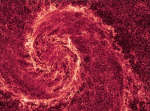 The Whirlpool Galaxy in Infrared Dust
26.01.2011
How do spiral galaxies form stars? To help find out, the Hubble Space Telescope imaged the nearby photogenic spiral M51 in infrared light to highlight the dust that traces the dense gas that best forms stars. To further isolate the dust, much of the optical light from stars has also been digitally removed.
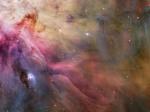 LL Ori and the Orion Nebula
20.01.2006
This esthetic close-up of cosmic clouds and stellar winds features LL Orionis, interacting with the Orion Nebula flow. Adrift in Orion's stellar nursery and still in its formative years, variable star LL Orionis produces a wind more energetic than the wind from our own middle-aged Sun.
 A Lunar Eclipse on Solstice Day
20.12.2010
Sometime after sunset tonight, the Moon will go dark. This total lunar eclipse, where the entire Moon is engulfed in the shadow of the Earth, will be visible from all of North America, while the partial phase of this eclipse will be visible throughout much of the rest of the world.
 Pandora s Cluster of Galaxies
9.06.2023
This deep field mosaicked image presents a stunning view of galaxy cluster Abell 2744 from the James Webb Space Telescope's NIRCam. Also dubbed Pandora's Cluster, Abell 2744 itself appears to be a ponderous merger of three different massive galaxy clusters some 3.5 billion light-years away toward the constellation Sculptor.
 Clusters, Hartley, and the Heart
14.10.2010
An alluring Comet Hartley 2 cruised through planet Earth's night sky on October 8, passing within about a Full Moon's width of the famous double star cluster in Perseus. The much anticipated...
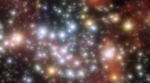 Journey to the Center of the Galaxy
29.07.2018
What wonders lie at the center of our Galaxy? In Jules Verne's science fiction classic A Journey to the Center of the Earth, Professor Liedenbrock and his fellow explorers encounter many strange and exciting wonders.
|
January February March April May |
|||||||||||||||||||||||||||||||||||||||||||||||||