
|
You entered: gas
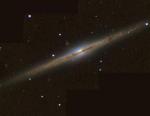 Edge On Spiral Galaxy NGC 891
20.12.1998
Is our Galaxy this thin? We believe so. The Milky Way, like NGC 891 pictured above, has the width of a typical spiral galaxy. Spirals have most of their bright stars, gas, and obscuring dust in a thin disk.
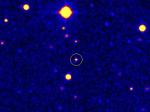 Mystery Object Explained
28.09.1999
Explorers often discover the unexpected. Such was the case when the Second Palomar Observatory Sky Survey chanced upon the unusual object circled in the above photograph. The so-called mystery object appeared star-like but displayed colors unlike most stars or quasars.
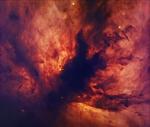 Flame Nebula Close Up
2.02.2007
Of course, the Flame Nebula is not on fire. Also known as NGC 2024, the nebula's suggestive reddish color is due to the glow of hydrogen atoms at the edge of the giant Orion molecular cloud complex some 1,500 light-years away.
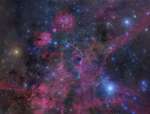 Vela Supernova Remnant
6.03.2008
The plane of our Milky Way Galaxy runs through this complex and beautiful skyscape. At the northwestern edge of the constellation Vela (the Sails) the 16 degree wide, 30 frame mosaic is centered on the glowing filaments of the Vela Supernova Remnant, the expanding debris cloud from the death explosion of a massive star.
 Carina Pillar and Jets
1.10.2009
This cosmic pillar of gas and dust is nearly 2 light-years wide. The structure lies within one of our galaxy's largest star forming regions, the Carina Nebula, shining in southern skies at a distance of about 7,500 light-years.
 Despina, Moon of Neptune
16.01.2014
Despina is a tiny moon of Neptune. A mere 148 kilometers across, diminutive Despina was discovered in 1989, in images from the Voyager 2 spacecraft taken during its encounter with the solar system's most distant gas giant planet.
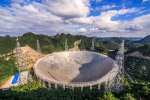 Five Hundred Meter Aperture Spherical Telescope
29.09.2016
The Five-hundred-meter Aperture Spherical Telescope (FAST) is nestled within a natural basin in China's remote and mountainous southwestern Guizhou province. Nicknamed Tianyan, or the Eye of Heaven, the new radio telescope is seen in this photograph taken near the start of its testing phase of operations on September 25.
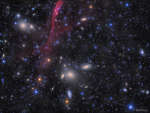 The Antlia Cluster of Galaxies
18.10.2016
Galaxies dot the sky in this impressively wide and deep image of the Antlia Cluster. The third closest cluster of galaxies to Earth after Virgo and Fornax, the Antlia cluster is known for its compactness and its high fraction of elliptical galaxies over (spirals.
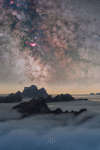 Clouds of Earth and Sky
24.07.2018
If you go high enough, you may find yourself on a picturesque perch between the water clouds of the Earth and the star clouds of the Milky Way. Such was the case last month for one adventurous alpinist astrophotographer.
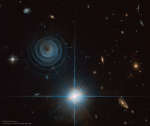 The Extraordinary Spiral in LL Pegasi
29.11.2021
What created the strange spiral structure on the upper left? No one is sure, although it is likely related to a star in a binary star system entering the planetary nebula phase, when its outer atmosphere is ejected.
|
January February |
|||||||||||||||||||||||||||||||||||||||||||||||||