
|
You entered: southern sky
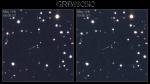 GRB 990510: Another Unusual Gamma Ray Burst
26.05.1999
Another huge explosion has lit up the universe, and astronomers are studying it as best they can before the light fades away. Two weeks ago, the BATSE instrument on the orbiting NASA Great Observatory Compton detected unusually bright flashes of gamma-rays from a point deep in the southern sky.
 3 ATs
3 ATs
4.05.2024
Despite their resemblance to R2D2, these three are not the droids you're looking for. Instead, the enclosures house 1.8 meter Auxiliary Telescopes (ATs) at Paranal Observatory in the Atacama Desert region of Chile.
 APOD: 2026 June 17 Б Longmore 8: The Hamster Wheel Nebula
17.06.2026
How did a hamster wheel get into space? The Hamster Wheel Nebula (Longmore 8) was discovered by Andrew Longmore in 1976 as a part of a larger survey of the southern sky. This survey...
 Good Morning Planets from Chile
17.06.2022
On June 15, innermost planet Mercury had wandered about as far from the Sun as it ever gets in planet Earth's sky. Near the eastern horizon just before sunrise it stands over distant Andes mountain peaks in this predawn snapshot from the valley of Rio Hurtado in Chile.
 APOD: 2024 June 4 Б Comet Pons Brooks Develops Opposing Tails
4.06.2024
Why does Comet Pons-Brooks now have tails pointing in opposite directions? The most spectacular tail is the blue-glowing ion tail that is visible flowing down the image. The ion tail is pushed directly out from the Sun by the solar wind. On the upper right is the glowing central coma of Comet 12P/PonsБBrooks.
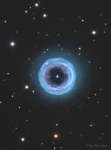 APOD: 2026 March 4 Б Shapley 1: An Annular Planetary Nebula
4.03.2026
WhatБs looking back at you isnБt a cosmic eye, but Shapley 1, a beautifully symmetric planetary nebula. Shapley 1, also known as the Fine Ring Nebula or PLN 329+2.1, bejewels the southern sky constellation of the Carpenter's Square (Norma).
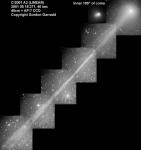 LINEAR s Tail and Two Nuclei
31.05.2001
Arcing toward southern skies in late March, this faint comet LINEAR - the one officially designated C/2001 A2 (LINEAR) - brightened unexpectedly. The outburst, apparently due to the fragmentation of its nucleus, delighted observers as the comet eventually increased to naked-eye brightness.
 APOD: 2025 January 20 Б Comet ATLAS Rounds the Sun
20.01.2025
Why does Comet ATLAS have such colorful tails? Last week Comet C/2024 G3 (ATLAS) passed its closest to the Sun -- well inside the orbit of Mercury -- and brightened dramatically. Unfortunately, the comet was then so angularly near the Sun that it was very hard for humans to see. But NASA's SOHO spacecraft saw it.
 The Large Cloud of Magellan
19.12.2008
The 16th century Portuguese navigator Ferdinand Magellan and his crew had plenty of time to study the southern sky during the first circumnavigation of planet Earth. As a result, two fuzzy cloud-like objects easily...
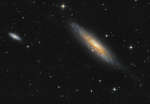 Sculptor Galaxy NGC 134
4.03.2016
NGC 134 is probably not the best known spiral galaxy in the constellation Sculptor. Still, the tantalizing island universe is a clearly a telescopic treasure in southern skies. It shares a bright core, clumpy...
|
January February March April May June July August |
||||||||||||||||||||||||||||||||||||||||||||||||||||||||