
|
You entered: planetary system
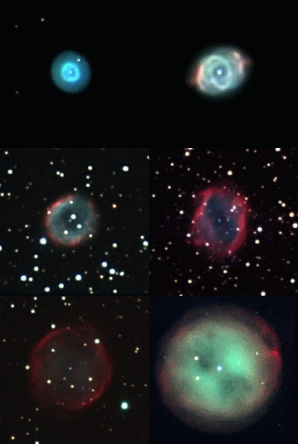 The Planetary Nebula Show
3.10.2001
What do the Owl, the Cat's Eye, the Ghost of Jupiter, and Saturn have in common? They're all planetary nebulae of course(!), glowing gaseous shrouds shed by dying sun-like stars as they run out of nuclear fuel.
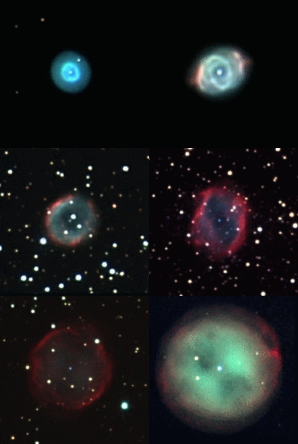 The Planetary Nebula Show
14.06.2003
What do the Owl, the Cat's Eye, the Ghost of Jupiter, and Saturn have in common? They're all planetary nebulae of course, glowing gaseous shrouds shed by dying sun-like stars as they run out of nuclear fuel.
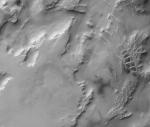 Rectangular Ridges on Mars
1.10.2002
What could cause rectangular ridges on Mars? As data flows in from the two spacecraft currently orbiting Mars, surface structures are seen that are not immediately understood. These structures pose puzzles that planetary geologists are eager to solve, as they might provide clues to past processes that have shaped Mars over billions of years.
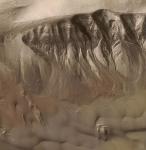 Gullies on Mars
24.10.2002
The Gullies of Mars would probably not have been sensational enough for the title of a vintage Edgar Rice Burroughs story about the Red Planet. But it would get the attention of planetary scientists today.
 In the Glare of Alpha Centauri
28.06.2012
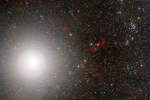
The glare of Alpha Centauri, one of the brightest stars in planet Earth's night sky, floods the left side of this southern skyscape. A mere 4.3 light-years distant, Alpha Centauri actually consists of two component stars similar in size to the Sun, locked in a mutual orbit.
 NGC 6302: The Butterfly Nebula
2.06.1998
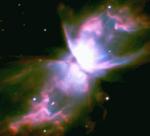
The Butterfly Nebula is only thousands of years old. As a central star of a binary system aged, it threw off its outer envelopes of gas in a strong stellar wind. The remaining stellar core is so hot it ionizes the previously ejected gas, causing it to glow.
 M57: The Ring Nebula
4.05.1998
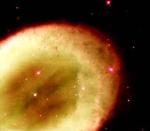
It looked like a ring on the sky. Hundreds of years ago astronomers noticed a nebula with a most unusual shape. Now known as M57 or NGC 6720, the gas cloud became popularly known as the Ring Nebula.
 Good Morning Planets from Chile
17.06.2022
On June 15, innermost planet Mercury had wandered about as far from the Sun as it ever gets in planet Earth's sky. Near the eastern horizon just before sunrise it stands over distant Andes mountain peaks in this predawn snapshot from the valley of Rio Hurtado in Chile.
 Shapley 1: An Annular Planetary Nebula
25.06.2000
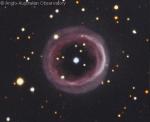
What happens when a star runs out of nuclear fuel? The center condenses into a white dwarf while the outer atmospheric layers are expelled into space and appear as a planetary nebula. This particular planetary nebula, designated Shapley 1 after the famous astronomer Harlow Shapley, has a very apparent annular ring like structure.
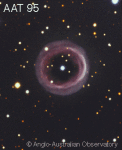 Shapley 1: An Annular Planetary Nebula
15.02.1997
What happens when a star runs out of nuclear fuel? The center condenses into a white dwarf while the outer atmospheric layers are expelled into space and appear as a planetary nebula. This particular planetary nebula, designated Shapley 1 after the famous astronomer Harlow Shapley, has a very apparent annular ring like structure.
|
January February March April May June July August September |
|||||||||||||||||||||||||||||||||||||||||||||||||