
|
You entered: magellanic clouds
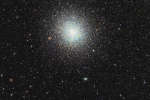 47 Tuc: A Great Globular Cluster of Stars
26.08.2008
Stars come in bunches. Of the over 200 globular star clusters that orbit the center of our Milky Way Galaxy, 47 Tucanae is the second brightest globular cluster (behind Omega Centauri). Light takes about...
 LMC X-1: A Black Hole Candidate
29.12.1995
The strongest source of X-rays in the Large Magellanic Cloud originates from an unusually energetic binary star system. This strong source, dubbed LMC X-1, is thought to be a normal and compact star orbiting each other. Gas stripped of the normal star falls onto the compact star, heats up, and emits X-rays.
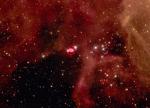 A Supernova Starfield
8.02.1999
Bright stars don't last forever. A bright star similar to others in this field exploded in a spectacular supernova that was witnessed on Earth in 1987. The result is visible even today as unusual rings and glowing gas. The above picture is a composite of recent images taken over several years.
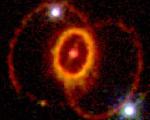 The Mysterious Rings of Supernova 1987A
5.02.2000
What's causing those odd rings in supernova 1987A? In 1987, the brightest supernova in recent history occurred in the Large Magellanic Clouds. At the center of the picture is an object central to the remains of the violent stellar explosion.
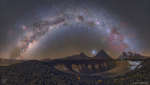 Milky Way over Chilean Volcanoes
20.08.2017
Sometimes, the sky mimics the ground. Taken in 2017 May from the Atacama Desert in Chile, the foreground of the featured image encompasses the dipping edge of the caldera of an extinct volcano. Poetically echoing the dip below is the arch of our Milky Way Galaxy above.
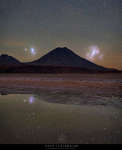 Magellanic Mountain
27.04.2018
Flanked by satellite galaxies of the Milky Way a volcanic peak rises from this rugged horizon. The southern night skyscape looks toward the south over Laguna Lejia and the altiplano of the Antofagasta Region of northern Chile.
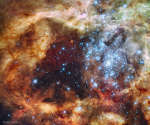 Star Cluster R136 Bursts Out
23.01.2016
In the center of star-forming region 30 Doradus lies a huge cluster containing some of the largest, hottest, and most massive stars known. These stars, known collectively as star cluster R136, were captured in the featured image in visible light by the Wide Field Camera 3 in 2009 peering through the Hubble Space Telescope.
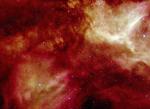 N159 and the Papillon Nebula
20.12.2003
In a search for massive stars, the Hubble Space Telescope has peered into yet another spectacular region of star formation. This nebula, known as N159, spans over 150 light-years and is located in the neighboring Large Magellanic Cloud galaxy, about 170,000 light years distant.
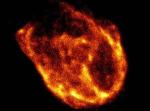 Supernova Remnant N132D in X Rays
13.09.1999
Thousands of years after a star explodes, an expanding remnant may still glow brightly. Such is the case with N132D, a supernova remnant located in the neighboring Large Magellanic Cloud galaxy. The expanding shell from this explosion now spans 80 light-years and has swept up about 600 Suns worth of mass.
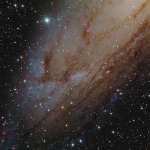 NGC 206 and the Star Clouds of Andromeda
24.10.2012
The large stellar association cataloged as NGC 206 is nestled within the dusty arms of neighboring spiral galaxy Andromeda (M31), 2.5 million light-years distant. Seen near the center of this gorgeous close-up of the southwestern extent of Andromeda's disk, the bright, blue stars of NGC 206 indicate its youth.
|
January February March April May June July August September |
|||||||||||||||||||||||||||||||||||||||||||||||||