
|
You entered: ionization region
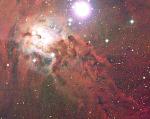 The Fox Fur Nebula
1.07.2002
The nebula surrounding bright star S Mon is filled with dark dust and glowing gas. The strange shapes that surrounding this star originate from fine interstellar dust reacting in complex ways with the energetic light and hot gas being expelled by the young stars.
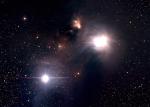 Dust and Gas Surrounding Star R Coronae Australis
16.10.2000
Young star R Coronae Australis has a dusty home. The dust is so thick on the upper left of the above photograph that little light from background stars comes through. Thinner dust near the stars reflects light from R Coronae Australis (upper right) and neighbor TY Coronae Australis, giving their surroundings a flowing appearance.
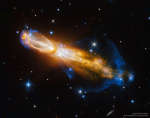 The Calabash Nebula from Hubble
15.02.2017
Fast expanding gas clouds mark the end for a central star in the Calabash Nebula. The once-normal star has run out of nuclear fuel, causing the central regions to contract into a white dwarf. Some of the liberated energy causes the outer envelope of the star to expand.
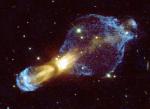 The Making of the Rotten Egg Nebula
3.09.2001
Fast expanding gas clouds mark the end for a central star in the Rotten Egg Nebula. The once-normal star has run out of nuclear fuel, causing the central regions to contract into a white dwarf. Some of the liberated energy causes the outer envelope of the star to expand.
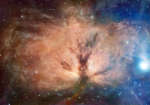 The Flame Nebula in Visible and Infrared
8.12.2014
What lights up the Flame Nebula? Fifteen hundred light years away towards the constellation of Orion lies a nebula which, from its glow and dark dust lanes, appears, on the left, like a billowing fire. But fire, the rapid acquisition of oxygen, is not what makes this Flame glow.
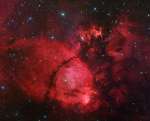 The Color of IC 1795
13.10.2011
This sharp cosmic portrait features glowing gas and obscuring dust clouds in IC 1795, a star forming region in the northern constellation Cassiopeia. Also cataloged as NGC 896, the nebula's remarkable details, shown...
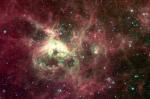 The Tarantula Nebula from Spitzer
2.02.2004
In the heart of monstrous Tarantula Nebula lies one of the most unusual star clusters. Known as NGC 2070 or R136, it is home to a great number of hot young stars. The energetic light from these stars continually ionizes nebula gas, while their energetic particle wind blows bubbles and defines intricate filaments.
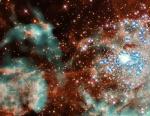 Star Cluster R136 Bursts Out
30.07.2001
In the center of star-forming region 30 Doradus lies a huge cluster of the largest, hottest, most massive stars known. Known as R136, the cluster's energetic stars are breaking out of the cocoon of gas and dust from which they formed.
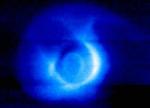 Earth's Plasmasphere
31.01.2001
Our Earth is surrounded by plasma. The overall shape that this ionized gas plasmasphere takes was discovered last year by NASA's robot IMAGE spacecraft, and shown in the recently released above image in ultraviolet light.
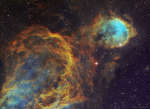 WR32 and Interstellar Clouds in Carina
8.02.2021
Stars can be like artists. With interstellar gas as a canvas, a massive and tumultuous Wolf-Rayet star has created the picturesque ruffled half-circular filaments called WR32, on the image left. Additionally, the winds...
|
January February March April May June July August |
||||||||||||||||||||||||||||||||||||||||||||||||||||||||