
|
You entered: equinox
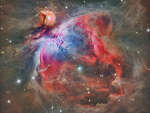 M42: Inside the Orion Nebula
20.03.2013
The Great Nebula in Orion, an immense, nearby starbirth region, is probably the most famous of all astronomical nebulas. Here, glowing gas surrounds hot young stars at the edge of an immense interstellar molecular cloud only 1500 light-years away.
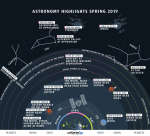 Highlights of the North Spring Sky
13.03.2019
What can you see in the night sky this season? The featured graphic gives a few highlights for Earth's northern hemisphere. Viewed as a clock face centered at the bottom, early (northern) spring sky events fan out toward the left, while late spring events are projected toward the right.
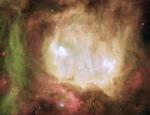 Halloween and the Ghost Head Nebula
31.10.2001
Halloween's origin is ancient and astronomical. Since the fifth century BC, Halloween has been celebrated as a cross-quarter day, a day halfway between an equinox (equal day / equal night) and a solstice (minimum day / maximum night in the northern hemisphere). With our modern calendar, however, the real cross-quarter day will occur next week.
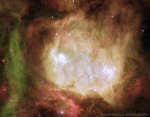 Halloween and the Ghost Head Nebula
30.10.2016
Halloween's origin is ancient and astronomical. Since the fifth century BC, Halloween has been celebrated as a cross-quarter day, a day halfway between an equinox (equal day / equal night) and a solstice (minimum day / maximum night in the northern hemisphere).
 Solstice Sun and Milky Way
21.12.2017
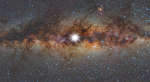
Welcome to December's solstice, first day of winter in the north and summer for the southern hemisphere. Astronomical markers of the seasons, solstice and equinox dates are based on the Sun's place in its annual journey along the ecliptic, through planet Earth's sky.
 Halloween and the Ghost Head Nebula
24.10.2021
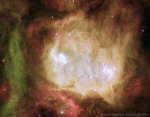
Halloween's origin is ancient and astronomical. Since the fifth century BC, Halloween has been celebrated as a cross-quarter day, a day halfway between an equinox (equal day / equal night) and a solstice (minimum day / maximum night in the northern hemisphere).
 Opposite the Sun
18.09.2010
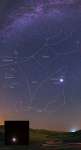
Chances are the brightest star you've seen lately is actually planet Jupiter. Jupiter rules the sky in this labeled view of a starry September night from the Alborz mountains in Iran, complete with the trail of a red flashlight illuminating the mountain road.
 Springtime Comet Fever
20.03.1997
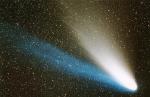
Today marks the Vernal Equinox, the first day of Spring for planet Earth's northern hemisphere. Despite recent attempts by other spectacular and dramatic celestial events to take center stage, Comet Hale-Bopp remains the most popular object in the sky (according to APOD access logs!) and is likely to make this spring memorable for many.
 Moons Beyond the Rings of Saturn
12.07.2010
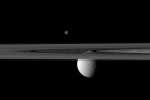
What's happened to that moon of Saturn? Nothing -- Saturn's moon Rhea is just partly hidden behind Saturn's rings. In April, the robotic Cassini spacecraft now orbiting Saturn took this narrow-angle view looking across the Solar System's most famous rings.
 Crescent Rhea Occults Crescent Saturn
20.07.2008
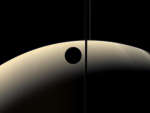
Soft hues, partially lit orbs, a thin trace of the ring, and slight shadows highlight this understated view of the majestic surroundings of the giant planet Saturn. Looking nearly back toward the Sun, the robot Cassini spacecraft now orbiting Saturn captured crescent phases of Saturn and its moon Rhea in color a few years ago.
|
January February March April May June July August |
||||||||||||||||||||||||||||||||||||||||||||||||||||||||