
|
You entered: Jupiter's Moons
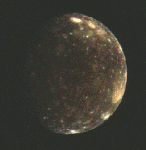 Callisto: Dark Smashed Iceball
6.09.1995
Callisto is a dirty battered world, showing the most beaten surface of Jupiter's major moons. Made of a rocky core covered by fractured ice, Callisto's past collisions with large meteors are evident as large craters surrounded by concentric rings.
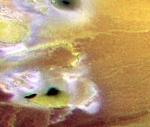 Calderas And Cliffs Near Io's South Pole
27.04.2000
Braving intense radiation belts, the Galileo spacecraft once again flew past the surface of Jupiter's moon Io (sounds like EYE-oh) on February 22. Combining high resolution black and white images from that flyby...
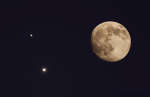 Venus and Jupiter are Close
2.07.2015
On June 30, Venus and Jupiter were close in western skies at dusk. Near the culmination of this year's gorgeous conjunction, the two bright evening planets are captured in the same telescopic field of view in this image taken after sunset from Bejing, China.
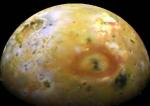 Io's Giant Volcano Pele
5.12.1996
Io has some very large volcanoes. One of the largest is evident near the center of the above photograph and named Pele, for the mythological Polynesian fire goddess. The Galileo spacecraft now orbiting Jupiter took this picture of Jupiter's most active moon in June, although it was released just last week.
 Io Aurora
16.10.1998
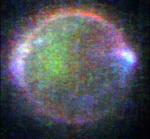
Alluring aurora surrounding Io (eye-oh) appear as a ghostly glow while the volcanic moon orbits within Jupiter's dark shadow. Gas giant Jupiter is off to the right of this image, recorded in May by the robot Galileo spacecraft's solid state imaging camera from a distance of about 1.3 million kilometers.
 Venus, Moon, and Neighbors
6.04.2000
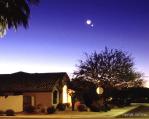
Rising before the Sun on February 2nd, astrophotographer Joe Orman anticipated this apparition of the bright morning star Venus near a lovely crescent Moon above a neighbor's house in suburban Phoenix, Arizona, USA.
 Volcano Euboea Fluctus On Io
8.09.1996
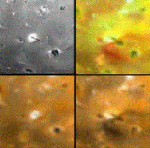
Jupiter's moon Io is turning out to be our Solar System's geologic powerhouse. The churning moon was photographed again just recently on June 27th and again shows signs of violent activity. Shown above are photographs of the volcano Euboea Fluctus taken at different times.
 The Colorful Moon
16.03.2002
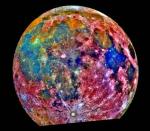
Do you recognize the Earth's Moon when you see it? The crazy, patchwork appearance of the false-color image makes this almost full view of the Moon's familiar near side look very strange.
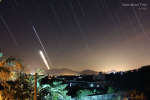 A Fading Moonset Over Hong Kong
15.12.2009
Do stars appear dimmer when nearer the horizon? Yes -- atmospheric air absorbs and reradiates light, so that the greater the airmass through which one peers, the fainter an object will appear. Pictured above in a multi-frame image, stars, the planet Jupiter, and even the Moon show the horizon-dimming effects of Earth's nearly-transparent atmosphere.
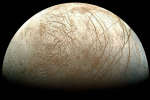 Gibbous Europa
2.12.2007
Although the phase of this moon might appear familiar, the moon itself might not. In fact, this gibbous phase shows part of Jupiter's moon Europa. The robot spacecraft Galileo captured this image mosaic during its mission orbiting Jupiter from 1995 - 2003.
|
January February March April May June July August September |
|||||||||||||||||||||||||||||||||||||||||||||||||