
|
You entered: star cluster
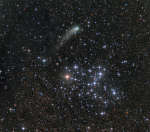 Messier 6 and Comet Siding Spring
17.10.2014
This looks like a near miss but the greenish coma and tail of Comet Siding Spring (C/2013 A1) are really 2,000 light-years or so away from the stars of open cluster Messier 6. They do appear close together though, along the same line-of-sight in this gorgeous October 9th skyscape toward the constellation Scorpius.
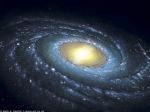 Milky Way Illustrated
4.01.2005
What does our Milky Way Galaxy look like from afar? Since we are stuck inside, and since opaque dust truncates our view in visible light, nobody knows for sure. Drawn above, however, is a good guess based on many different types of observations.
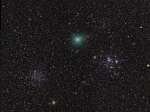 The Comet Hartley 2 Cruise
7.10.2011
Early last November, small but active Comet Hartley 2 (103/P Hartley) became the fifth comet imaged close-up by a spacecraft from planet Earth. Still cruising through the solar system with a 6 year orbital period, Hartley 2 is is making astronomical headlines again, though.
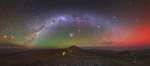 Milky Way with Airglow Australis
3.02.2017
Captured last April after sunset on a Chilean winter's night an exceptionally intense airglow flooded this scene. The panoramic skyscape is also filled with stars, clusters, and nebulae along the southern Milky Way including the Large and Small Magellanic clouds.
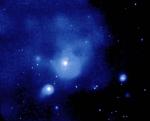 Fornax Cluster in Motion
24.09.2004
Reminiscent of popular images of the lovely Pleiades star cluster that lies within our own Milky Way Galaxy, this false-color x-ray view actually explores the center of a much more extended cosmic family -- the Fornax cluster of galaxies some 65 million light-years away.
 When Z is for Mars
15.04.2023
A composite of images captured about a week apart from mid August 2022 through late March 2023, this series traces the retrograde motion of ruddy-colored Mars. Progressing from lower right to upper left Mars...
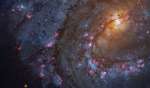 In the Arms of M83
11.11.2011
Big, bright, and beautiful, spiral galaxy M83 lies a mere twelve million light-years away, near the southeastern tip of the very long constellation Hydra. This cosmic close-up, a mosaic based on data from...
 APOD: 2024 January 1 Б NGC 1232: A Grand Design Spiral Galaxy
1.01.2024
Galaxies are fascinating not only for what is visible, but for what is invisible. Grand spiral galaxy NGC 1232, captured in detail by one of the Very Large Telescopes, is a good example.
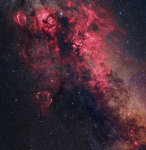 Cygnus Skyscape
25.07.2019
In brush strokes of interstellar dust and glowing hydrogen gas, this beautiful skyscape is painted across the plane of our Milky Way Galaxy near the northern end of the Great Rift and the constellation Cygnus the Swan.
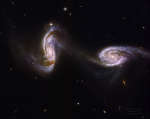 Arp 240: A Bridge between Spiral Galaxies from Hubble
28.11.2016
Why is there a bridge between these two spiral galaxies? Made of gas and stars, the bridge provides strong evidence that these two immense star systems have passed close to each other and experienced violent tides induced by mutual gravity.
|
January February March April May |
|||||||||||||||||||||||||||||||||||||||||||||||||