
|
You entered: outer Galaxy
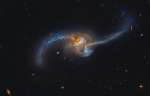 Merging NGC 2623
19.10.2012
NGC 2623 is really two galaxies that are becoming one. Seen to be in the final stages of a titanic galaxy merger, the pair lies some 300 million light-years distant toward the constellation Cancer.
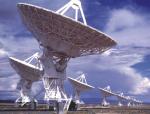 The Very Large Array of Radio Telescopes
28.05.2002
The most photogenic array of radio telescopes in the world has also been one of the most productive. Each of the 27 radio telescopes in the Very Large Array (VLA) is the size of a house and can be moved on train tracks.
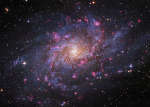 The Hydrogen Clouds of M33
3.10.2019
Gorgeous spiral galaxy M33 seems to have more than its fair share of glowing hydrogen gas. A prominent member of the local group of galaxies, M33 is also known as the Triangulum Galaxy and lies a mere 3 million light-years away.
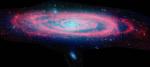 Infrared Andromeda
9.06.2006
This wide, detailed Spitzer Space Telescope view features infrared light from dust (red) and old stars (blue) in Andromeda, a massive spiral galaxy a mere 2.5 million light-years away. In fact, with over twice the diameter of our own Milky Way, Andromeda is the largest nearby galaxy.
 Edwin Hubble Discovers the Universe
26.04.2020
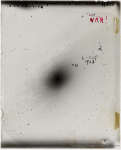
How big is our universe? This very question, among others, was debated by two leading astronomers 100 years ago today in what has become known as astronomy's Great Debate. Many astronomers then believed that our Milky Way Galaxy was the entire universe. Many others, though, believed that our galaxy was just one of many.
 The Hubble Deep Field
1.09.2002
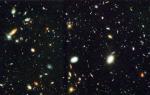
Galaxies like colorful pieces of candy fill the Hubble Deep Field - one of humanity's most distant optical views of the Universe. The dimmest, some as faint as 30th magnitude (about four billion times...
 The Hooker Telescope on Mt. Wilson
1.07.1995
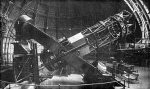
In the 1920s, pictures from the Hooker Telescope on Mt. Wilson fundamentally changed our understanding of the cosmos. Astronomer Edwin Hubble, using photographs he took with this telescope, demonstrated that the objects his contemporaries called "spiral nebulae" were actually huge systems of stars - spiral galaxies, similar to our own Milky Way galaxy but incredibly distant.
 APOD: 2025 October 26 Б Halloween and the Ghost Head Nebula
26.10.2025
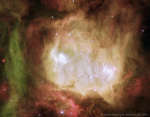
Halloween's origin is ancient and astronomical. Since the fifth century BC, Halloween has been celebrated as a cross-quarter day, a day halfway between an equinox (equal day / equal night) and a solstice (minimum day / maximum night in the northern hemisphere).
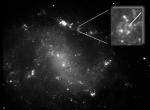 ESO 184 G82: and the Supernova Gamma Ray Burst Connection
28.02.2002
Modern astronomers keep a long list of things that go bump in the night. Near the top are supernovae - the death explosions of massive stars, and gamma-ray bursts - the most powerful explosions seen across the Universe.
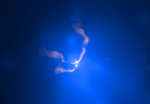 Two Black Holes Dancing in 3C 75
28.09.2014
What's happening at the center of active galaxy 3C 75? The two bright sources at the center of this composite x-ray (blue)/ radio (pink) image are co-orbiting supermassive black holes powering the giant radio source 3C 75.
|
January February March April May June July August September |
|||||||||||||||||||||||||||||||||||||||||||||||||