
|
You entered: Earth's moon
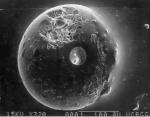 A Spherule from Outer Space
12.01.2003
When a meteorite strikes the Moon, the energy of the impact melts some of the splattering rock, a fraction of which might cool into tiny glass beads. Many of these glass beads were present in lunar soil samples returned to Earth by the Apollo missions.
 The Largest Rock Known
1.01.1998
There, that faint dot in the center - that's the largest rock known. It is larger than every known asteroid, moon, and comet nucleus. It is larger than any other rocky planet. (Nobody knows...
 The Largest Rock Known
2.01.2000
There, that faint dot in the center - that's the largest rock known. It is larger than every known asteroid, moon, and comet nucleus. It is larger than any other rocky planet. (Nobody knows...
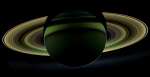 Saturn at Night
22.12.2012
Splendors seldom seen are revealed in this glorious picture from Saturn's shadow. Imaged by Cassini on October 17, 2012 during its 174th orbit, the ringed planet's night side is viewed from...
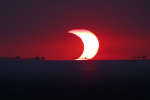 A Partial Eclipse Over Manila Bay
28.01.2009
What's happened to the setting Sun? An eclipse! Two days ago, the Moon eclipsed part of the Sun as visible from parts of Africa, Australia, and Asia. In particular the above image, taken from the Mall of Asia seawall, caught a partially eclipsed Sun setting over Manila Bay in the Philippines.
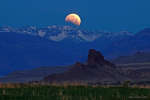 Eclipsed Moon Over Wyoming
6.06.2012
A setting full moon rarely looks like this. Monday morning just before a fully lit Strawberry Moon dropped behind the Absaroka Mountain Range near Cody, Wyoming, USA, the shadow of the Earth got in the way.
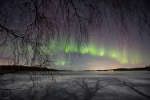 Aurora by Moonlight
12.02.2022
The ice was singing as light from a bright gibbous Moon cast shadows across this frozen lake, about 20 kilometers north of Stockholm, Sweden, planet Earth. In the alluring night skyscape captured on February 10, shimmering auroral curtains of light dance in the evening sky.
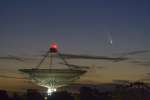 PanSTARRS over Parkes
9.03.2013
Sweeping quickly through southern skies on March 5, Comet PanSTARRS (C/2011 L4) follows the Sun toward the western horizon in this twilight scene. In the foreground is Australia's CSIRO Parkes Radio Telescope, a 64 meter wide steerable dish that is no stranger to the space age exploration of comets.
 Annular Eclipse After Sunrise
2.03.2017
From northern Patagonia, morning skies were clear and blue on Sunday, February 26. This sweeping composite scene, overlooking Hermoso Valle, Facundo, Chubut, Argentina, follows the Sun after sunrise, capturing an annular solar eclipse. Created...
 Planets In The Sun
5.05.2000
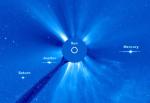
Today, all five naked-eye planets (Mercury, Venus, Mars, Jupiter, Saturn) plus the Moon and the Sun will at least approximately line-up. As viewed from planet Earth, they will be clustered within about 26 degrees, the closest alignment for all these celestial bodies since February 1962, when there was a solar eclipse!
|
January February March April May June July August September |
|||||||||||||||||||||||||||||||||||||||||||||||||