
|
You entered: Earth orbit
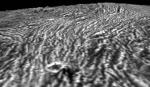 Oceans Under Jupiter's Ganymede
18.12.2000
The search for extraterrestrial life came back into our own Solar System last week with the announcement that there may be liquid oceans under the surface of Jupiter's moon Ganymede. Ganymede now joins Callisto and Europa as moons of Jupiter that may harbor seas of liquid water under layers of surface ice.
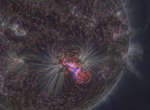 Solar Flare from a Sharper Sun
21.11.2014
Solar active region AR2192 was the largest recorded sunspot group of the last 24 years. Before rotating off the Earth-facing side of the Sun at the end of October, it produced a whopping six energetic X-class flares.
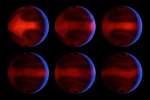 A Dangerous Summer on HD 80606b
4.02.2009
On the distant planet HD 80606b, summers might be dangerous. Hypothetic life forms floating in HD 080606b's atmosphere or lurking on one of its (presently hypothetical) moons might fear the 1,500 Kelvin summer heat, which is hot enough not only to melt lead but also nickel.
 Fomalhaut's Dusty Debris Disk
11.05.2023
Fomalhaut is a bright star, a 25 light-year voyage from planet Earth in the direction of the constellation Piscis Austrinus. Astronomers first noticed Fomalhaut's excess infrared emission in the 1980s. Space and ground-based...
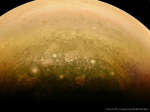 Clouds Near Jupiters South Pole from Juno
25.10.2016
What's happening near the south pole of Jupiter? Recent images sent back by NASA's robotic Juno spacecraft are showing an interesting conglomeration of swirling clouds and what appear to be white ovals.
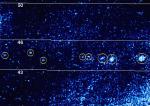 Lightning on Jupiter
12.05.1997
Does lightning occur only on Earth? Spacecraft in our Solar System have detected radio signals consistent with lightning on other planets, including Venus, Jupiter, Saturn, Uranus, and Neptune. In the above photograph, optical flashes from Jupiter were photographed recently by the Galileo orbiter. Each of the circled dots indicates lightning.
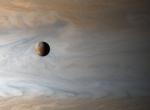 Io: Moon Over Jupiter
20.04.2001
How big is the Jovian moon Io? The most volcanic body in the Solar System, Io (usually pronounced "EYE-oh") is 3,600 kilometers in diameter, about the size of planet Earth's single large natural satellite.
 A Powerful Solar Flare
29.10.2003
Yesterday, our Sun produced one of the most powerful solar flares in recorded history. Seen across the electromagnetic spectrum, the Sun briefly became over 100 times brighter in X-rays than normal. Over the next few days, as energetic particles emitted from these regions strike the Earth, satellite communications might be affected and auroras might develop.
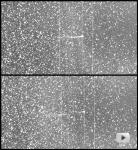 Comet Encke s Tail Ripped off
3.10.2007
Swinging inside the orbit of Mercury, on April 20th periodic comet Encke encountered a blast from the Sun in the form of a Coronal Mass Ejection (CME). When CMEs, enormous clouds of energetic particles ejected from the Sun, slam into Earth's magnetosphere, they often trigger auroral displays.
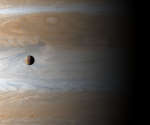 Io: Moon Over Jupiter
8.04.2012
How big is Jupiter's moon Io? The most volcanic body in the Solar System, Io (usually pronounced "EYE-oh") is 3,600 kilometers in diameter, about the size of planet Earth's single large natural satellite.
|
January February March April May June July August September October |
|||||||||||||||||||||||||||||||||||||||||||||||||