
|
You entered: massive stars
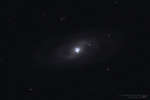 The Einstein Cross Gravitational Lens
17.12.2017
Most galaxies have a single nucleus -- does this galaxy have four? The strange answer leads astronomers to conclude that the nucleus of the surrounding galaxy is not even visible in this image. The central cloverleaf is rather light emitted from a background quasar.
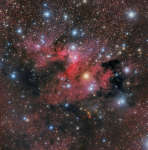 The Light, the Dark, and the Dusty
5.03.2020
This colorful skyscape spans about four full moons across nebula rich starfields along the plane of our Milky Way Galaxy in the royal northern constellation Cepheus. Near the edge of the region's massive...
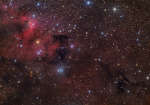 The Light, the Dark, and the Dusty
11.06.2015
This colorful skyscape spans about three full moons (1.5 degrees) across nebula rich starfields along the plane of our Milky Way Galaxy in the royal northern constellation Cepheus. Near the edge of the region...
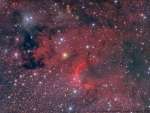 The Light, the Dark, and the Dusty
28.09.2018
This colorful skyscape spans about two full moons across nebula rich starfields along the plane of our Milky Way Galaxy in the royal northern constellation Cepheus. Near the edge of the region's massive...
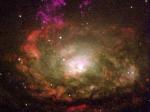 The Circinus Galaxy
4.12.2000
Powerful forces are at play in the nearby Circinus Galaxy. Hot gas, colored pink, is being ejected out of the spiral galaxy from the central region. Much of Circinus' tumultuous gas, however, is concentrated in two rings.
 APOD: 2025 April 7 Б NGC 4414: A Flocculent Spiral Galaxy
7.04.2025
How much mass do flocculent spirals hide? The featured image of flocculent spiral galaxy NGC 4414 was taken with the Hubble Space Telescope to help answer this question. Flocculent spirals -- galaxies without well-defined spiral arms -- are a quite common form of galaxy, and NGC 4414 is one of the closest.
 Sunrise from the Surface of Gliese 581c
2.05.2007
How might a sunrise appear on Gliese 581c? One artistic guess is shown above. Gliese 581c is the most Earth-like planet yet discovered and lies a mere 20 light-years distant. The central red dwarf...
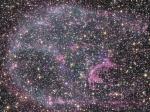 Supernova Remnant N132D in Optical and X Rays
25.10.2005
Thousands of years after a star exploded, its expanding remnant still glows brightly across the spectrum. Such is the case with N132D, a supernova remnant located in the neighboring Large Magellanic Cloud (LMC) galaxy. The expanding shell from this explosion now spans 80 light-years and has swept up about 600 Suns worth of mass.
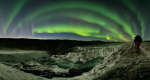 Waterfalls, Auroras, Comet: Iceland
26.03.2013
If not distracted by the picturesque landscape, waterfalls, stars, and auroras, you might be able to find Comet PANSTARRS. The above image, capturing multiple terrestrial and celestial wonders in a single shot, was taken last week in southwest Iceland.
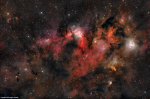 The Light, the Dark, and the Dusty
30.11.2022
This colorful skyscape spans about four full moons across nebula rich starfields along the plane of our Milky Way Galaxy in the royal northern constellation Cepheus. Near the edge of the region's massive...
|
January February March April May June July August September October |
|||||||||||||||||||||||||||||||||||||||||||||||||