
|
You entered: nearest stars
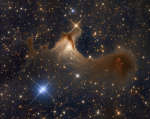 Ghost of the Cepheus Flare
30.10.2010
Spooky shapes seem to haunt this starry expanse, drifting through the night in the royal constellation Cepheus. Of course, the shapes are cosmic dust clouds faintly visible in dimly reflected starlight. Far from your...
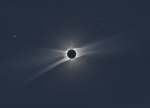 A Darkened Sky
20.09.2008
For a moment on August 1st, the daytime sky grew dark along the path of a total solar eclipse. While watching the geocentric celestial event from Mongolia, photographer Miloslav Druckmuller recorded multiple images with two separate cameras as the Moon blocked the bright solar disk and darkened the sky.
 The Deep Lagoon
27.09.2023
Ridges of glowing interstellar gas and dark dust clouds inhabit the turbulent, cosmic depths of the Lagoon Nebula. Also known as M8, The bright star forming region is about 5,000 light-years distant. It makes for a popular stop on telescopic tours of the constellation Sagittarius toward the center of our Milky Way Galaxy.
 Deep Magellanic Clouds Image Indicates Collisions
24.07.2016
Did the two most famous satellite galaxies of our Milky Way Galaxy once collide? No one knows for sure, but a detailed inspection of deep images like that featured here give an indication that they have.
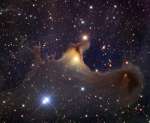 Ghost of the Cepheus Flare
31.10.2011
Spooky shapes seem to haunt this starry expanse, drifting through the night in the royal constellation Cepheus. Of course, the shapes are cosmic dust clouds faintly visible in dimly reflected starlight. Far from your...
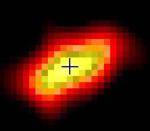 HR 4796A: A Recipe for Planets
22.04.1998
Two hundred and twenty light years from Earth, planets are forming. Recent observations of the binary star system HR 4796 have shown that one of the stars is surrounded by a dusty gaseous disk. This disk is of the right size, age, and density for dust pellets to accrete surrounding matter.
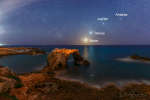 Celestial Alignment over Sicilian Shore
3.03.2019
This was a sunrise to remember. About a month ago, just before the dawn of the Sun, an impressive alignment of celestial objects was on display to the east. Pictured, brightest and closest to the horizon, is the Moon.
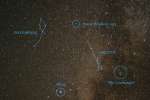 Nova Delphini 2013
16.08.2013
Using a small telescope to scan the skies on August 14, Japanese amateur astronomer Koichi Itagaki discovered a "new" star within the boundaries of the constellation Delphinus. Indicated in this skyview captured on August 15 from Stagecoach, Colorado, it is now appropriately designated Nova Delphini 2013.
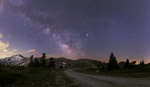 Milky Way and Planets Near Opposition
20.05.2016
In this early May night skyscape, a mountain road near Bursa, Turkey seems to lead toward bright planets Mars and Saturn and the center of our Milky Way Galaxy, a direction nearly opposite the Sun in planet Earth's sky.
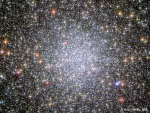 Globular Star Cluster 47 Tuc
18.05.2015
Globular star cluster 47 Tucanae is a jewel box of the southern sky. Also known as NGC 104, it roams the halo of our Milky Way Galaxy along with over 150 other globular star clusters.
|
January February March April May June July August September October |
|||||||||||||||||||||||||||||||||||||||||||||||||