
|
You entered: Earth orbit
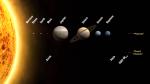 Eight Planets and New Solar System Designations
28.08.2006
How many planets are in the Solar System? This popular question now has a new formal answer according the International Astronomical Union (IAU): eight. Last week, the IAU voted on a new definition for planet and Pluto did not make the cut.
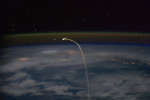 Shuttle Reentry Streak from Orbit
1.08.2011
What's that strange bright streak? It is the last image ever of a space shuttle from orbit. A week and a half ago, after decoupling from the International Space Station, the Space Shuttle Atlantis fired its rockets for the last time, lost its orbital speed, and plummeted back to Earth.
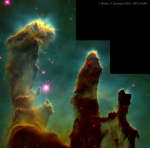 M16: Pillars of Star Creation
24.04.2016
Newborn stars are forming in the Eagle Nebula. This image, taken with the Hubble Space Telescope in 1995, shows evaporating gaseous globules (EGGs) emerging from pillars of molecular hydrogen gas and dust. The giant pillars are light years in length and are so dense that interior gas contracts gravitationally to form stars.
 APOD: 2006 January 1- The Largest Rock in the Solar System
1.01.2006
There, that faint dot in the center - that's the largest rock known in our Solar System. It is larger than every known asteroid, moon, and comet nucleus. It is larger than any other local rocky planet.
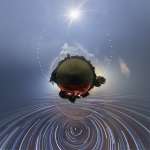 Little Planet Astro Camp
2.09.2016
Day and night on this little planet look a lot like day and night on planet Earth. In fact, the images used to construct the little planet projection, a digitally warped and stitched mosaic covering 360x180 degrees, were taken during day and night near Tarján, Hungary, planet Earth.
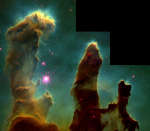 M16: Pillars of Creation
22.07.2012
It was one of the most famous images of the 1990s. This image, taken with the Hubble Space Telescope in 1995, shows evaporating gaseous globules (EGGs) emerging from pillars of molecular hydrogen gas and dust. The giant pillars are light years in length and are so dense that interior gas contracts gravitationally to form stars.
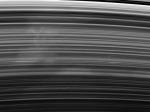 Mysterious Spokes in Saturns Rings
27.11.2006
What causes the mysterious spokes in Saturn's rings? Visible on the left of the above image as ghostlike impressions, spokes were first discovered by the Voyager spacecraft that buzzed by Saturn in the early 1980s. Their existence was unexpected, and no genesis hypothesis has ever become accepted.
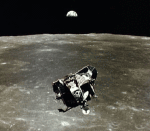 The Eagle Soars
21.07.1996
On July 21, 1969 Apollo 11 astronauts Neil A. Armstrong and Edwin E. "Buzz" Aldrin Jr. lifted off the lunar surface in the ascent stage of their lunar module dubbed "The Eagle" -- after becoming the first to walk on the moon.
 Rosetta and Comet Outbound
28.11.2015
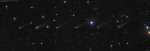
Not a bright comet, 67P/Churyumov-Gerasimenko now sweeps slowly through planet Earth's predawn skies near the line-up of planets along the ecliptic. Still, this composite of telescopic images follows the comet's progress as it moves away from the Sun beyond the orbit of Mars, from late September (left) through late November (far right).
 Globular Cluster 47 Tucanae from SALT
5.09.2005
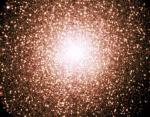
Stars come in bunches. Of the over 200 globular star clusters that orbit the center of our Milky Way Galaxy, 47 Tucanae is the second brightest globular cluster, behind Omega Centauri. Known to some affectionately as 47 Tuc or NGC 104, it is only visible from Earth's Southern Hemisphere.
|
January February March April May June July August September October |
|||||||||||||||||||||||||||||||||||||||||||||||||