
|
You entered: star
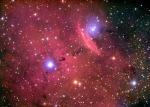 Emission and Reflection in NGC 6559
23.10.2001
Bright gas and dark dust permeate the space between stars in a nebula known as NGC 6559. The gas, primarily hydrogen, is responsible for the diffuse red glow of the emission nebula. As energetic...
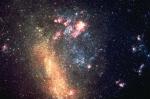 Neighboring Galaxy: The Large Magellanic Cloud
22.02.2000
The brightest galaxy visible from our own Milky Way Galaxy is the Large Magellanic Cloud (LMC). Visible predominantly from Earth's Southern Hemisphere, the LMC is the second closest galaxy, neighbor to the Small Magellanic Cloud, and one of eleven known dwarf galaxies that orbit our Milky Way Galaxy.
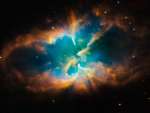 Planetary Nebula NGC 2818
22.01.2009
NGC 2818 is a beautiful planetary nebula, the gaseous shroud of a dying sun-like star. It could well offer a glimpse of the future that awaits our own Sun after spending another 5 billion years or so steadily using up hydrogen at its core, and then finally helium, as fuel for nuclear fusion.
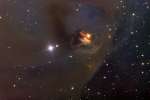 T Tauri and Hind s Variable Nebula
26.03.2011
The yellowish star near center in this remarkable telescopic skyview is T Tauri, prototype of the class of T Tauri variable stars. Nearby it is a dusty yellow cosmic cloud historically known as Hind's Variable Nebula (NGC 1555).
 Messier s Eleven
12.07.2013
This fifteen degree wide field of view stretches across the crowded starfields of Sagittarius toward the center of our Milky Way galaxy. In fact, the center of the galaxy lies near the right edge of the rich starscape and eleven bright star clusters and nebulae fall near the center of the frame.
 M33: Triangulum Galaxy
17.09.2016
The small, northern constellation Triangulum harbors this magnificent face-on spiral galaxy, M33. Its popular names include the Pinwheel Galaxy or just the Triangulum Galaxy. M33 is over 50,000 light-years in diameter, third largest in the Local Group of galaxies after the Andromeda Galaxy (M31), and our own Milky Way.
 Spiral Galaxy NGC 2841
23.03.2023
A mere 46 million light-years distant, spiral galaxy NGC 2841 can be found in planet Earth's night sky toward the northern constellation of Ursa Major. This sharp image centered on the gorgeous island universe also captures spiky foreground Milky Way stars and more distant background galaxies within the same telescopic field of view.
 APOD: 2024 January 9 Б Thors Helmet
9.01.2024
Thor not only has his own day (Thursday), but a helmet in the heavens. Popularly called Thor's Helmet, NGC 2359 is a hat-shaped cosmic cloud with wing-like appendages. Heroically sized even for a Norse god, Thor's Helmet is about 30 light-years across.
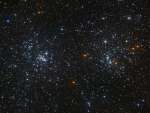 Double Cluster in Perseus
7.12.2007
Skygazers recently following Comet Holmes have probably also chanced across this lovely starfield, not far from the comet on the sky in the constellation Perseus. Some 7,000 light-years away, this pair of open or galactic star clusters is an easy binocular target and is visible to the unaided eye from dark sky areas.
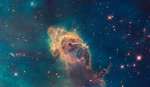 Carina Pillar and Jets
1.10.2009
This cosmic pillar of gas and dust is nearly 2 light-years wide. The structure lies within one of our galaxy's largest star forming regions, the Carina Nebula, shining in southern skies at a distance of about 7,500 light-years.
|
January February March April May June July August September |
|||||||||||||||||||||||||||||||||||||||||||||||||