
|
You entered: Earth orbit
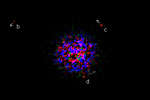 HR 8799: Discovery of a Multi planet Star System
17.11.2008
How common are planetary systems like our own Solar System? In the twelve years previous to 2008, over 300 candidate planetary systems have been found orbiting nearby stars. None, however, were directly imaged, few showed evidence for multiple planets, and many had a Jupiter-sized planet orbiting inside the orbit of Mercury.
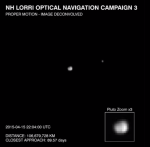 Approaching Pluto
27.05.2015
Here comes Pluto. NASA's robotic New Horizons spacecraft is now beyond the orbit of Neptune and closing fast on the Solar System's most famous unexplored world. The featured time lapse video shows...
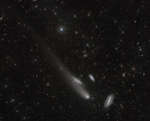 Three Galaxies and a Comet
21.12.2023
Distant galaxies abound in this one degree wide field of view toward the southern constellation Grus (The Crane). But the three spiral galaxies at the lower right are quite striking. In fact, all three galaxies are grouped about 70 million light years away and sometimes known as the Grus Triplet.
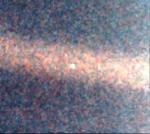 The Largest Rock Known
1.01.1998
There, that faint dot in the center - that's the largest rock known. It is larger than every known asteroid, moon, and comet nucleus. It is larger than any other rocky planet. (Nobody knows...
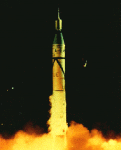 The First Explorer
18.05.1997
The first US spacecraft was Explorer 1. The cylindrical 30 pound satellite was launched (above) as the fourth stage of a Jupiter-C rocket (a modified US Army Redstone ballistic missile) and achieved orbit on January 31, 1958.
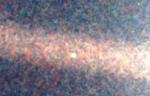 The Largest Rock Known
2.01.2000
There, that faint dot in the center - that's the largest rock known. It is larger than every known asteroid, moon, and comet nucleus. It is larger than any other rocky planet. (Nobody knows...
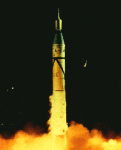 The First Explorer
10.02.1996
The first US spacecraft was Explorer 1. The cylindrical 30 pound satellite was launched (above) as the fourth stage of a Jupiter-C rocket (a modified US Army Redstone ballistic missile) and achieved orbit on January 31, 1958.
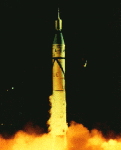 The First Explorer
6.02.1999
The first US spacecraft was Explorer 1. The cylindrical 30 pound satellite was launched (above) as the fourth stage of a Jupiter-C rocket (a modified US Army Redstone ballistic missile) and achieved orbit on January 31, 1958.
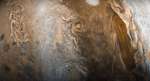 Orbiting Jupiter
7.06.2017
What would it be like to orbit Jupiter? The dramatic featured video depicts just this and was made from images taken by NASA's Juno spacecraft currently orbiting the Jovian giant. Juno recently completed its sixth pass near Jupiter during its looping elliptical six-week orbit.
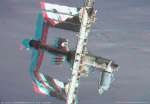 Stereo Space Station
23.02.2008
Get out your red-blue glasses and float next to the International Space Station (ISS), planet Earth's largest artificial moon. This fun stereo view was constructed from parts of two separate images (S122-E-009880, S122-E-009893) and an additional background recorded as the shuttle orbiter Atlantis undocked from the ISS on February 18.
|
January February March April May June July August September October |
|||||||||||||||||||||||||||||||||||||||||||||||||