
|
You entered: sunspot
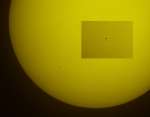 Atlantis and Hubble Side by Side
16.05.2009
On Wednesday, May 13, two, tiny, fast moving spots crossed an otherwise featureless solar disk. Not sunspots though, the dark blemishes were silhouettes of the shuttle orbiter Atlantis and the Hubble Space Telescope side by side.
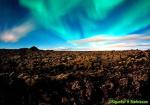 Aurora Over Clouds
2.04.2001
Aurorae usually occur high above the clouds. The auroral glow is created when fast-moving particles ejected from the Sun impact air molecules high in the Earth's atmosphere. An oxygen molecule, for example, will glow in a green light when reacquiring an electron lost during a collision with a solar particle.
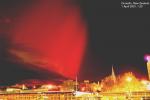 Aurora Over New Zealand
6.04.2001
Last weekend skygazers at middle and high latitudes around the globe were treated to expansive auroral displays as a magnetic storm raged around planet Earth. The storm was triggered by a solar coronal mass ejection associated with the giant sunspot group cataloged as active region number 9393.
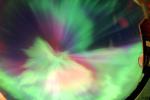 A Full Sky Multi Colored Auroral Corona
9.11.2004
On some nights the sky is the most interesting show in town. This fisheye picture captures a particularly active and colorful auroral corona that occurred two days ago over l'Observatoire de la Decouverte in Val Belair near Quebec, Canada.
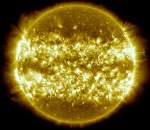 A Year on the Sun
26.04.2013
Our solar system's miasma of incandescent plasma, the Sun may look a little scary here. The picture is a composite of 25 images recorded in extreme ultraviolet light by the orbiting Solar Dynamics Observatory between April 16, 2012 and April 15, 2013.
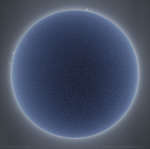 Blue Sun Bristling
4.11.2009
Our Sun may look like all soft and fluffy, but it's not. Our Sun is an extremely large ball of bubbling hot gas, mostly hydrogen gas. The above picture...
 APOD: 2025 July 30 Б Coronal Loops on the Sun
30.07.2025
Our Sun frequently erupts in loops. Hot solar plasma jumps off the Sun's surface into prominences, with the most common type of prominence being a simple loop. The loop shape originates from the Sun's magnetic field, which is traced by spiraling electrons and protons.
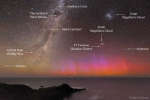 Red Aurora Over Australia
29.01.2017
Why would the sky glow red? Aurora. A solar storm in 2012, emanating mostly from active sunspot region 1402, showered particles on the Earth that excited oxygen atoms high in the Earth's atmosphere. As the excited element's electrons fell back to their ground state, they emitted a red glow.
 APOD: 2025 September 27 Б A Rocket in the Sun
27.09.2025
On the morning of September 24 a rocket crosses the bright solar disk in this long range telescopic snapshot captured from Orlando, Florida. That's about 50 miles north of its Kennedy Space Center launch site. This rocket carried three new space weather missions to space.
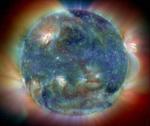 Solstice Celebration
21.06.2000
Season's greetings! At 01:48 Universal Time on June 21 the Sun reaches its northernmost point in planet Earth's sky marking a season change and the first solstice of the year 2000. In celebration, consider this delightfully detailed, brightly colored image of the active Sun.
|
January February March April May June July August |
||||||||||||||||||||||||||||||||||||||||||||||||||||||||