
|
You entered: shadow
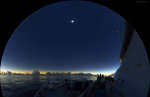 6 Minutes 42 Seconds
30.07.2009
The July 22nd total solar eclipse was the longest of the 21st century. From the point of maximum eclipse along the Moon's shadow track across the Pacific Ocean, the Moon completely blocked the Sun for a total of 6 minutes and 39 seconds.
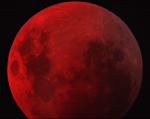 Dark Lunar Eclipse
30.08.2007
The Moon passed close to the center of Earth's shadow on August 28th. Seen best by skywatchers in western North America, and the Pacific region, the resulting total lunar eclipse was a dark one, lasting about 90 minutes.
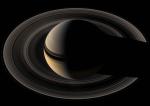 Crescent Saturn
23.10.2007
Saturn never shows a crescent phase -- from Earth. But when viewed from beyond, the majestic giant planet can show an unfamiliar diminutive sliver. This image of crescent Saturn in natural color was taken by the robotic Cassini spacecraft in May.
 Diamonds in the Sky
19.04.2024
When the dark shadow of the Moon raced across North America on April 8, sky watchers along the shadow's narrow central path were treated to a total solar eclipse. During the New Moon's shadow play diamonds glistened twice in the eclipse-darkened skies.
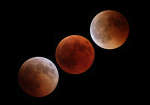 Central Lunar Eclipse
2.08.2018
Reddened by scattered sunlight, the Moon in the center is passing through the center of Earth's dark umbral shadow in this July 27 lunar eclipse sequence. Left to right the three images are from the start, maximum, and end to 103 minutes of totality from the longest lunar eclipse of the 21st century.
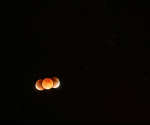 Earthshadow and the Beehive
2.02.2018
The Earth's dark umbral shadow is shaped like a cone extending into space. Of course its circular cross section at the distance of the Moon is more easily seen during a lunar eclipse.
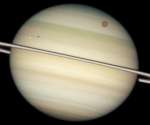 Saturn: Moons in Transit
18.03.2009
Every 14 to 15 years, Saturn's rings are tilted edge-on to our line of sight. As the bright, beautiful rings seem to grow narrower it becomes increasingly difficult to see them, even with large telescopes. But it does provide the opportunity to watch multiple transits of Saturn's moons.
 APOD: 2025 September 6 Б Sardinia Sunset
5.09.2025
When the sun sets on September 7, the Full Moon will rise. And on that date denizens around much of our fair planet, including parts of Antarctica, Australia, Asia, Europe, and Africa can witness a total lunar eclipse, with the Moon completely immersed in Earth's shadow.
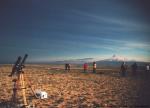 Vanishing Umbra
8.04.2006
During the March 29 total solar eclipse, the Moon's dark central shadow or umbra is vanishing beyond the horizon in this dramatic view of the landscape a few kilometers southeast of Incesu, Anatolia, Turkey. The large, snow covered mountain in the distance is 3,250 meter high volcano Hasan Dag.
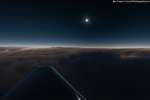 Eclipse at 44 000 Feet
7.11.2013
Timing was critical to catch this image of November 3rd's solar eclipse. But flying at 44,000 feet, intrepid eclipse chasers on a chartered jet traveling 500 miles per hour managed to intercept the the Moon's shadow. The remarkable flight made a perpendicular crossing of the central shadow track.
|
January February March April May June July August September |
|||||||||||||||||||||||||||||||||||||||||||||||||