
|
You entered: magnetic field
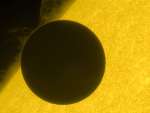 Venus at the Edge
9.06.2012
As its June 6 2012 transit begins Earth's sister planet crosses the edge of the Sun in this stunning view from the Hinode spacecraft. The timing of limb crossings during the rare transits was used historically to triangulate the distance to Venus and determine a value for the Earth-Sun distance called the astronomical unit.
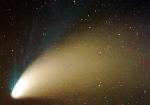 Hale-Bopp's Fickle Ion Tail
14.05.1997
What's happening to Comet Hale-Bopp's blue ion tail? The comet's ion tail is fluctuating more rapidly as it passes a region of changing solar wind. As the comet passes from north to south, it crosses the plane of the Sun's equator, where the solar magnetic field changes direction.
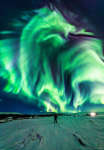 Dragon Aurora over Iceland
18.02.2019
Have you ever seen a dragon in the sky? Although real flying dragons don't exist, a huge dragon-shaped aurora developed in the sky over Iceland earlier this month. The aurora was caused...
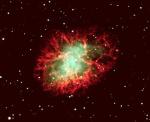 M1: Filaments of the Crab Nebula
8.02.1998
The Crab Nebula, filled with mysterious filaments, is the result of a star that exploded in 1054 AD. This spectacular supernova explosion was recorded by Chinese and (quite probably) Anasazi Indian astronomers. The filaments...
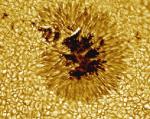 A Sunspot Up Close
5.10.1998
Sometimes, small regions of the Sun appear unusually dark. Visible above is a close-up picture of a sunspot, a depression on the Sun's face that is slightly cooler and less luminous than the rest of the Sun.
 APOD: 2023 April 3 Б The Galactic Center Radio Arc
3.04.2023
What causes this unusual curving structure near the center of our Galaxy? The long parallel rays slanting across the top of the featured radio image are known collectively as the Galactic Center Radio Arc and point out from the Galactic plane.
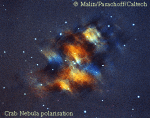 M1: Polarization of the Crab
23.11.1995
The Crab Nebula resulted from a star that exploded - a supernova. Although the stellar explosion that caused the Crab Nebula was seen over 900 years ago, the nebula itself still expands and shines. Much of the emitted light has been found to be polarized. Light waves with the same polarization vibrate in the same plane.
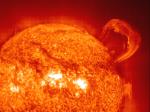 A Solar Prominence from SOHO
16.04.2006
How can gas float above the Sun? Twisted magnetic fields arching from the solar surface can trap ionized gas, suspending it in huge looping structures. These majestic plasma arches are seen as prominences above the solar limb.
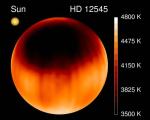 A Giant Starspot on HD 12545
12.07.2000
What could cause a star to have such a large spot? Our Sun itself frequently has sunspots, relatively cool dark magnetic depressions that move across its surface. HD 12545, however, exhibits the largest starspots yet observed.
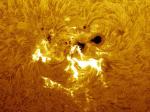 A Large Active Region Crosses the Sun
26.07.2004
An unexpectedly large sunspot region is now crossing the Sun. The active region is home to rivers of hot plasma, explosive flares, strong magnetic fields, a powerful Coronal Mass Ejection (CME), and a sunspot group so large it can be seen by the protected eye without magnification.
|
January February March April May June July August September October |
|||||||||||||||||||||||||||||||||||||||||||||||||