
|
You entered: galactic plane
 Fermi Catalogs the Gamma ray Sky
17.03.2010
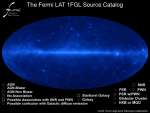
What shines in the gamma-ray sky? The most complete answer yet to that question is offered by the Fermi Gamma-ray Space Telescope's first all-sky catalog. Fermi's sources of cosmic gamma-rays feature nature...
 The Milky Way's Gamma-Ray Halo
4.11.1997
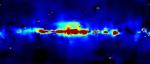
Our Milky Way galaxy appears to be surrounded by a halo of gamma rays. Gamma rays are the most energetic form of electromagnetic radiation, with more than a hundred thousand times the energy of visible light, but known gamma-ray sources don't account for the diffuse distribution of this high-energy glow.
 Exploring The Universe With IUE (1978-1996)
30.09.1996
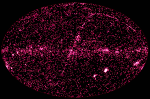
How do planets, stars, and galaxies form? How do they evolve? The International Ultraviolet Explorer (IUE) satellite was launched in 1978 and operated by NASA/ ESA/ PPARC to help provide answers to some of the most fundamental questions about the contents of our universe.
 The Milky Ring
21.01.2021
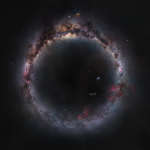
An expanse of cosmic dust, stars and nebulae along the plane of our Milky Way galaxy form a beautiful ring in this projected all-sky view. The creative panorama covers the entire galaxy visible from planet Earth, an ambitious 360 degree mosaic that took two years to complete.
 The Solar Neighborhood
24.02.1998
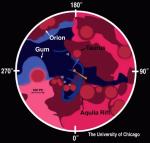
You are here. The orange dot in the above false-color drawing represents the current location of the Sun among local gas clouds in the spiral Milky Way Galaxy. These gas clouds are so thin that we usually see right through them. Nearly spherical bubbles surround regions of recent star formation.
 The COMPTEL Gamma-Ray Sky
29.05.1996
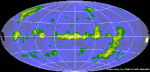
This premier gamma-ray view of the sky was produced by the COMPTEL instrument onboard NASA's orbiting Compton Gamma Ray Observatory. The entire sky is seen projected on a coordinate system centered on our Milky Way Galaxy with the plane of the Galaxy running across the middle of the picture.
 Journey to the Center of the Galaxy
20.01.1997
In Jules Verne's science fiction classic A Journey to the Center of the Earth, Professor Hardwigg and his fellow explorers encounter many strange and exciting wonders. What wonders lie at the center of our Galaxy?
 Where a Black Hole Roams
21.09.2001
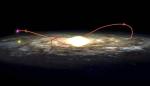
Black hole candidate XTE J1118+480 is known to roam the halo of our Milky Way Galaxy. This exotic system - thought to be a stellar mass black hole consuming matter from a companion star - was discovered only last year as a flaring celestial x-ray source.
 Aurigae Nebulae
24.02.2012
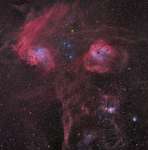
Rich in star clusters and nebulae, the ancient constellation of Auriga, the Charioteer, rides high in northern winter night skies. Composed from narrow and broadband filter data and spanning nearly 8 Full Moons (4 degrees) on the sky, this deep telescopic view recorded in January shows off some of Auriga's celestial bounty.
 Nebulae in Aurigae
30.11.2015
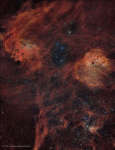
Rich in star clusters and nebulae, the ancient constellation of the Charioteer (Auriga) rides high in northern winter night skies. Composed from narrow and broadband filter data and spanning nearly 8 Full Moons (4 degrees) on the sky, this deep telescopic view shows off some of Auriga's celestial bounty.
|
January February March April May June July August |
||||||||||||||||||||||||||||||||||||||||||||||||||||||||