
|
You entered: filament
 Near the Center of the Lagoon Nebula
4.11.2019
Stars are battling gas and dust in the Lagoon Nebula but the photographers are winning. Also known as M8, this photogenic nebula is visible even without binoculars towards the constellation of the Archer (Sagittarius). The energetic processes of star formation create not only the colors but the chaos.
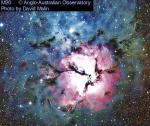 M20: The Trifid Nebula
31.03.1998
Unspeakable beauty and unimaginable bedlam can be found together in the Trifid Nebula. Also known as M20, this photogenic nebula is visible with good binoculars in the constellation of Sagittarius. The energetic processes of star formation create not only the colors but the chaos. The red-glowing gas results from high-energy light striking interstellar hydrogen gas.
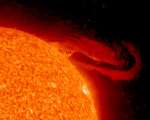 A Solar Prominence Unfurls
4.10.2008
On September 29, this magnificent eruptive solar prominence lifted away from the Sun's surface, unfurling into space over the course of several hours. Suspended in twisted magnetic fields, the hot plasma structure is many times the size of planet Earth and was captured in this view by the Sun-watching STEREO (Ahead) spacecraft.
 APOD: 2023 June 5 Б In the Center of the Trifid Nebula
5.06.2023
What's happening at the center of the Trifid Nebula? Three prominent dust lanes that give the Trifid its name all come together. Mountains of opaque dust appear near the bottom, while other dark filaments of dust are visible threaded throughout the nebula.
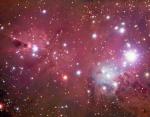 The Mysterious Cone Nebula
7.01.2002
Sometimes the simplest shapes are the hardest to explain. For example, the origin of the mysterious cone-shaped region seen on the far left remains a mystery. The interstellar formation, dubbed the Cone Nebula, is located about 2700 light years away.
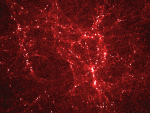 The Early Universe
14.06.1997
What did our universe look like when it was young? To answer this, cosmologists run sophisticated computer programs tracking the locations of millions of particles. The above animated frame is the result of such a calculation and shows how our universe might have looked when it was just a fracton of its current age.
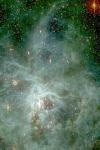 In the Heart of the Tarantula Nebula
27.10.1999
In the heart of monstrous Tarantula Nebula lies one of the most unusual star clusters. Known as NGC 2070 or R136, it is home to a great number of hot young stars. The energetic light from these stars continually ionizes nebula gas, while their energetic particle wind blows bubbles and defines intricate filaments.
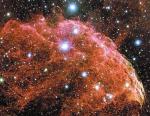 Galactic Supernova Remnant IC 443
3.09.2003
About 8000 years ago, a star in our Galaxy exploded. Ancient humans might have noticed the supernova as a temporary star, but modern humans can see the expanding shell of gas even today. Pictured...
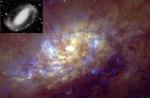 Starbirth in NGC 1808
23.03.1998
The center of galaxy NGC 1808 is bursting with new stars, but why? Being a barred spiral galaxy makes NGC 1808 somewhat similar to our own Milky Way Galaxy. But the disk of NGC 1808 (inset) is quite warped, and its center is unusually bright and blue.
 APOD: 2023 April 3 Б The Galactic Center Radio Arc
3.04.2023
What causes this unusual curving structure near the center of our Galaxy? The long parallel rays slanting across the top of the featured radio image are known collectively as the Galactic Center Radio Arc and point out from the Galactic plane.
|
January February March April May June July August September |
|||||||||||||||||||||||||||||||||||||||||||||||||