
|
You entered: Earth orbit
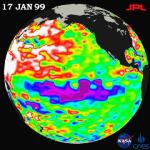 La Nina Earth
15.02.1999
La Niña is a temporary climate change caused by unusually cold water in the central Pacific Ocean. Cold water topping an unusually low sea level is shown as purple in the above false-color picture taken by the orbiting TOPEX/Poseidon satellite in mid-January.
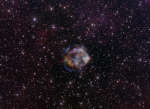 Cas A: Optical and X ray
17.01.2013
The aftermath of a cosmic cataclysm, supernova remnant Cassiopeia A (Cas A) is a comfortable 11,000 light-years away. Light from the Cas A supernova, the death explosion of a massive star, first reached Earth just 330 years ago.
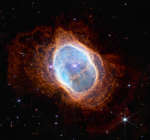 Webb s Southern Ring Nebula
14.07.2022
Cataloged as NGC 3132 the Southern Ring Nebula is a planetary nebula, the death shroud of a dying sun-like star some 2,500 light-years from Earth. Composed of gas and dust the stunning cosmic landscape is nearly half a light-year in diameter, explored in unprecedented detail by the James Webb Space Telescope.
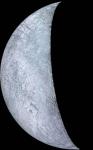 Crescent Europa
25.02.2002
Although the phase of this moon might appear familiar, the moon itself might not. In fact, this crescent shows part of Jupiter's moon Europa. The passing robot spacecraft Voyager 2 captured this image in 1979.
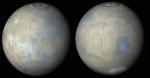 Mapping Mars
19.03.1999
This month, the Mars Global Surveyor (MGS) spacecraft began its primary mission to the red planet. Orbiting about once every two hours at an altitude of over 200 miles, instruments onboard MGS now regularly explore the Martian surface and atmosphere.
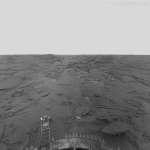 The Surface of Venus from Venera 13
17.03.2021
If you could stand on Venus -- what would you see? Pictured is the view from Venera 13, a robotic Soviet lander which parachuted and air-braked down through the thick Venusian atmosphere in March of 1982.
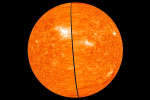 Sun 360: STEREO Captures Views of the Entire Sun
7.02.2011
For the first time, the entire Sun is being imaged all at once. This has become possible because the two STEREO satellites orbiting and monitoring the Sun are now on opposite sides of the Sun.
 APOD: 2025 May 11 Б The Surface of Venus from Venera 14
11.05.2025
If you could stand on Venus -- what would you see? Pictured is the view from Venera 14, a robotic Soviet lander which parachuted and air-braked down through the thick Venusian atmosphere in March of 1982.
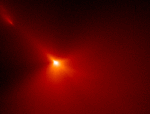 Near the Nucleus of Hyakutake
28.03.1996
NASA's Hubble Space Telescope captured this image of the near-nuclear region of Comet Hyakutake on March 25 as the comet approached within 9.3 million miles of the Earth. It covers a relatively "small" 2,000 mile wide area with the sunward direction toward the lower right (tailward is upper left).
 Night Lightning on Jupiter
16.12.1997
Why is there lightning on Jupiter? Lightning is a sudden rush of electrically charged particles from one location to another. To create lightning, charges must first separate inside a cloud. On Earth, drafts of colliding ice and water droplets usually create this charge separation, but what happens on Jupiter?
|
January February March April May June July August |
||||||||||||||||||||||||||||||||||||||||||||||||||||||||