
|
You entered: galaxies
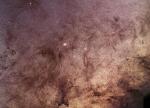 Stars and Dust Through Baades Window
23.12.2002
Billions of stars light up the direction toward the center of our Galaxy. The vast majority of these stars are themselves billions of years old, rivaling their home Milky Way Galaxy in raw age. These stars are much more faint and red than the occasional young blue stars that light up most galaxies.
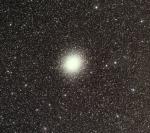 Omega Centauri
26.05.2006
Centaurus, the Centaur, is one of the most striking constellations in the southern sky. The Milky Way flows through this celestial expanse whose wonders also include the closest star to the sun, Alpha Centauri, and the largest globular star cluster in our galaxy, Omega Centauri.
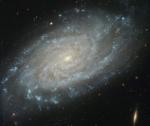 NGC 3370: A Sharper View
11.09.2003
Similar in size and grand design to our own Milky Way, spiral galaxy NGC 3370 lies about 100 million light-years away toward the constellation Leo. Recorded here in exquisite detail by the Hubble Space...
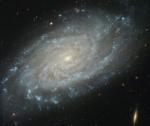 NGC 3370: A Sharper View
14.05.2005
Similar in size and grand design to our own Milky Way, spiral galaxy NGC 3370 lies about 100 million light-years away toward the constellation Leo. Recorded here in exquisite detail by the Hubble Space...
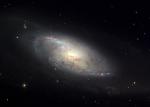 M106 in Canes Venatici
30.07.2005
Close to the Great Bear (Ursa Major) and surrounded by the stars of the Hunting Dogs (Canes Venatici), this celestial nebula was discovered in 1781 by the metric French astronomer Pierre Mechain. Later, it was added to the catalog of his friend and colleague Charles Messier as M106.
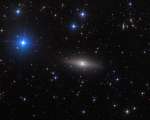 NGC 7814: The Little Sombrero in Pegasus
25.10.2013
Point your telescope toward the high flying constellation Pegasus and you can find this expanse of Milky Way stars and distant galaxies. Centered on NGC 7814, the pretty field of view would almost be covered by a full moon.
 Facing NGC 1232
18.04.2024
From our vantage point in the Milky Way Galaxy, we see NGC 1232 face-on. Nearly 200,000 light-years across, the big, beautiful spiral galaxy is located some 47 million light-years away in the flowing southern constellation of Eridanus. This sharp, multi-color, telescopic image of NGC 1232 includes remarkable details of the distant island universe.
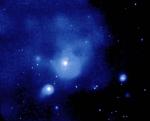 Fornax Cluster in Motion
24.09.2004
Reminiscent of popular images of the lovely Pleiades star cluster that lies within our own Milky Way Galaxy, this false-color x-ray view actually explores the center of a much more extended cosmic family -- the Fornax cluster of galaxies some 65 million light-years away.
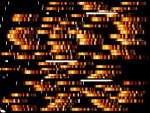 Breaking Distant Light
4.01.2009
In the distant universe, time appears to run slow. Since time-dilated light appears shifted toward the red end of the spectrum (redshifted), astronomers are able to use cosmological time-slowing to help measure vast distances in the universe.
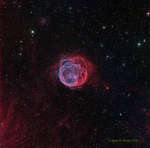 Henize 70: A Superbubble in the LMC
4.02.2019
Massive stars profoundly affect their galactic environments. Churning and mixing interstellar clouds of gas and dust, stars -- most notably those upwards of tens of times the mass of our Sun -- leave their mark on the compositions and locations of future generations of stars.
|
January February |
|||||||||||||||||||||||||||||||||||||||||||||||||