
|
You entered: Earth orbit
 Dione's Lagrange Moon Helene
9.10.1995
Saturn's moon Helene is very unusual in that it circles Saturn near the orbit of a bigger moon: Dione. Helene is situated in what is called a "Lagrange point" of Dione - a place of stability created by Dione's gravity.
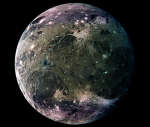 Ganymede Enhanced
20.09.2009
What does the largest moon in the Solar System look like? Ganymede, larger than even Mercury and Pluto, has a surface speckled with bright young craters overlying a mixture of older, darker, more cratered terrain laced with grooves and ridges.
 Comet ATLAS Breaks Up
15.04.2020
Cruising through the inner solar system, Comet ATLAS C2019/Y4 has apparently fragmented. Multiple separate condensations within its diffuse coma are visible in this telescopic close-up from April 12, composed of frames tracking the comet's motion against trailing background stars.
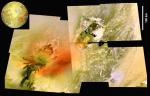 Io Volcano Culann Patera
17.12.2002
What causes the unusual colors surrounding Io's volcanoes? Io, the innermost large moon of Jupiter, is known to be the most tumultuous body in the Solar System. Approximately the size of Earth...
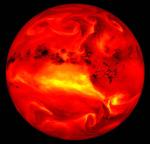 The Water Vapor Channel
22.03.2002
What alien planet's bizarre landscape lurks below these fiery-looking clouds? It's only planet Earth, of course ... as seen on the Water Vapor Channel. Hourly, images like this one (an infrared image shown in false-color) are brought to you by the orbiting Geostationary Operational Environmental Satellites' (GOES) multi-channel imagers.
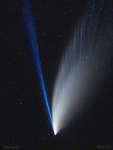 APOD: 2020 July 22 Б The Structured Tails of Comet NEOWISE
21.07.2020
What is creating the structure in Comet NEOWISE's tails? Of the two tails evident, the blue ion tail on the left points directly away from the Sun and is pushed out by the flowing and charged solar wind.
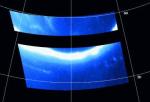 An Auroral Ring on Jupiter
9.06.1997
Do other planets have aurora? Terrestrial and spacecraft observations have found evidence for aurora on Venus, Mars, Jupiter, Saturn, Uranus, and Neptune. In the above false-color photograph, a good portion of an auroral ring was captured recently in optical light by the Galileo spacecraft in orbit around Jupiter.
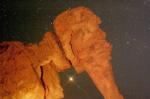 Mars Rising Behind Elephant Rock
28.08.2003
Yesterday, at about 10 am Universal Time, Mars and Earth passed closer than in nearly 60,000 years. Mars, noticeably red, remains the brightest object in the eastern sky just after sunset. The best...
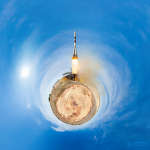 Little Planet Soyuz
14.06.2018
Engines blazing, a large rocket bids farewell to this little planet. Of course, the little planet is really planet Earth and the large rocket is a Soyuz-FG rocket. Launched from the Baikonur Cosmodrome in Kazakhstan on June 6 it carried a Soyuz MS-09 spacecraft into orbit.
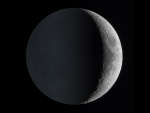 Sunshine, Earthshine
19.03.2015
Today's date marks an Equinox and a New Moon. Remarkably, while the exact timing of both geocentric events occur within a span of only 13 hours, the moon also reaches its new phase only 14 hours after perigee, the closest point in its orbit.
|
January February March April May June July August |
||||||||||||||||||||||||||||||||||||||||||||||||||||||||