
|
You entered: massive stars
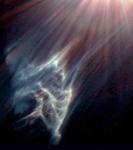 Reflecting Merope
5.12.2000
In the famous Pleiades star cluster, a star's light is slowly destroying a passing cloud of gas and dust. The star, Merope, lies just off the upper right edge of this recently released picture by the Hubble Space Telescope.
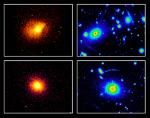 The Matter of Galaxy Clusters
24.10.2001
Situated over 2,000,000,000 (two billion) light-years from Earth, galaxies in cluster Abell 2390 (top) and MS2137.3-2353 (bottom) are seen in the right hand panels above, false-color images from the Hubble Space Telescope. Corresponding panels on the left reveal each cluster's x-ray appearance in images from the Chandra X-ray Observatory.
 The Large Cloud of Magellan
26.08.2015
The 16th century Portuguese navigator Ferdinand Magellan and his crew had plenty of time to study the southern sky during the first circumnavigation of planet Earth. As a result, two fuzzy cloud-like objects easily...
 The Large Cloud of Magellan
16.10.2010
The 16th century Portuguese navigator Ferdinand Magellan and his crew had plenty of time to study the southern sky during the first circumnavigation of planet Earth. As a result, two fuzzy cloud-like objects easily...
 70 Virginis b: A New Water Planet?
29.01.1996
The star 70 Virginis has a planet. This recent discovery is the second known case of a planet orbiting a normal star other than our Sun itself. The first case involved 51 Pegasi and was announced last year.
 HD 10180: Richest Yet Planetary System Discovered
25.08.2010
Do other rich planetary systems exist? Our Solar System has the most planets of any known star, most probably because it is so hard to detect planets around other stars. Sensitive measurements, though, have...
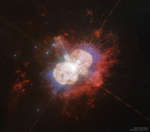 Doomed Star Eta Carinae
19.02.2019
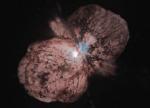
Eta Carinae may be about to explode. But no one knows when - it may be next year, it may be one million years from now. Eta Carinae's mass - about 100 times greater than our Sun - makes it an excellent candidate for a full blown supernova.
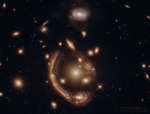 A Molten Galaxy Einstein Ring Galaxy
4.07.2022
It is difficult to hide a galaxy behind a cluster of galaxies. The closer cluster's gravity will act like a huge lens, pulling images of the distant galaxy around the sides and greatly distorting them. This is just the case observed in the featured image recently re-processed image from the Hubble Space Telescope.
 APOD: 2023 July 9 Б Doomed Star Eta Carinae
8.07.2023
Eta Carinae may be about to explode. But no one knows when - it may be next year, it may be one million years from now. Eta Carinae's mass - about 100 times greater than our Sun - makes it an excellent candidate for a full blown supernova.
 Doomed Star Eta Carinae
13.08.2000
Eta Carinae may be about to explode. But no one knows when - it may be next year, it may be one million years from now. Eta Carinae's mass - about 100 times greater than our Sun - makes it an excellent candidate for a full blown su
|
January February March April May |
|||||||||||||||||||||||||||||||||||||||||||||||||