
|
You entered: image
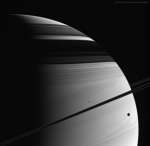 APOD: 2026 June 16 Б Moons, Rings, Shadows, Clouds: Saturn Cassini
16.06.2026
While cruising around Saturn, be on the lookout for picturesque arrangements of moons, rings, and shadows. One such striking sight occurred in 2005 and was captured by the then Saturn-orbiting Cassini spacecraft.
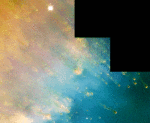 At the Edge of the Helix
22.04.1996
While exploring the inner edge of the Helix Nebula with the Hubble Space Telescope's Wide Field Planetary Camera 2, astronomers were able to produce this striking image - rich in details of an exotic environment.
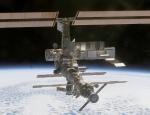 The International Space Station Expands Again
3.11.2002
The developing International Space Station (ISS) has changed its appearance yet again. Last month the Space Shuttle Atlantis visited the ISS and installed the third of eleven pieces that will compose the Integrated Truss Structure. The new S-1 Truss is visible on the right, below the extended solar panels across the top.
 At the Edge of the Helix
20.07.1997
While exploring the inner edge of the Helix Nebula with the Hubble Space Telescope's Wide Field Planetary Camera 2, astronomers were able to produce this striking image - rich in details of an exotic environment.
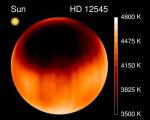 A Giant Starspot on HD 12545
2.11.2003
What could cause a star to have such a large spot? Our Sun itself frequently has sunspots, relatively cool dark magnetic depressions that move across its surface. HD 12545, however, exhibits the largest starspots yet observed.
 Retrograde Mars
11.05.2008
Why would Mars appear to move backwards? Most of the time, the apparent motion of Mars in Earth's sky is in one direction, slow but steady in front of the far distant stars. About every two years, however, the Earth passes Mars as they orbit around the Sun.
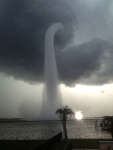 A Waterspout in Florida
17.07.2013
What's happening over the water? Pictured above is one of the better images yet recorded of a waterspout, a type of tornado that occurs over water. Waterspouts are spinning columns of rising moist air that typically form over warm water.
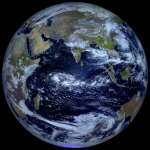 Equinox Earth
28.09.2013
From a geostationary orbit 36,000 kilometers above the equator, Russian meteorological satellite Elektro-L takes high-resolution images our fair planet every 30 minutes. But only twice a year, during an Equinox, can it capture an image like this one, showing an entire hemisphere bathed in sunlight.
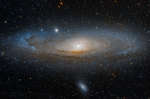 M31: The Andromeda Galaxy
30.07.2014
Andromeda is the nearest major galaxy to our own Milky Way Galaxy. Our Galaxy is thought to look much like Andromeda. Together these two galaxies dominate the Local Group of galaxies. The diffuse light from Andromeda is caused by the hundreds of billions of stars that compose it.
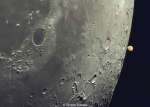 APOD: 2020 August 15 Б Mars at the Moons Edge
15.08.2020
Does the Moon ever block out Mars? Yes, the Moon occasionally moves in front of all of the Solar System's planets. Just this past Sunday, as visible from some locations in South America, a waning gibbous Moon eclipsed Mars.
|
January February March April May June July August September |
|||||||||||||||||||||||||||||||||||||||||||||||||