
|
You entered: Earth orbit
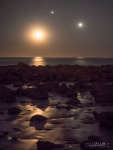 Triple Conjunction Over Galician National Park
24.06.2015
What are those bright objects hovering over the horizon? Planets -- and the Moon. First out, the horizon featured is a shoreline of the Atlantic Ocean that occurs at the Galicia National Park in northern Spain. Next furthest out, on the left, is the Moon.
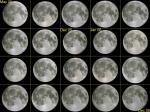 Twenty Full Moons
3.01.2007
In celebration of tonight's Full Moon, the first of 2007, consider this grid of twenty Full Moons. From upper left to lower right, the images represent every lunation from May 2005 through December 2006.
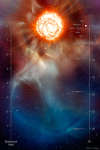 Betelgeuse Imagined
1.01.2020
Why is Betelgeuse fading? No one knows. Betelgeuse, one of the brightest and most recognized stars in the night sky, is only half as bright as it used to be only five months ago.
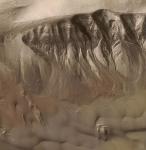 Gullies on Mars
24.10.2002
The Gullies of Mars would probably not have been sensational enough for the title of a vintage Edgar Rice Burroughs story about the Red Planet. But it would get the attention of planetary scientists today.
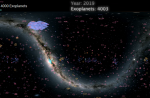 4000 Exoplanets
14.08.2022
Over 4000 planets are now known to exist outside our Solar System. Known as exoplanets, this milestone was passed last month, as recorded by NASA's Exoplanet Archive. The featured video highlights these exoplanets in sound and light, starting chronologically from the first confirmed detection in 1992 and continuing into 2019.
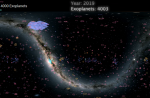 4000 Exoplanets
10.07.2019
Over 4000 planets are now known to exist outside our Solar System. Known as exoplanets, this milestone was passed last month, as recorded by NASA's Exoplanet Archive. The featured video highlights these exoplanets in sound and light, starting chronologically from the first confirmed detection in 1992.
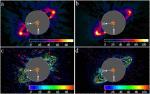 HR 4796A: Not Saturn
5.02.1999
These are not false-color renderings of the latest observations of Saturn's magnificent rings. Instead, the panels show a strikingly similar system on a much larger scale - a ring around the young, Vega-like star, HR 4796A, located about 200 light-years from Earth.
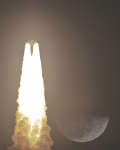 Artemis 1 Moonshot
19.11.2022
When the Artemis 1 mission's Orion spacecraft makes its November 21 powered flyby of the Moon, denizens of planet Earth will see the Moon in a waning crescent phase. The spacecraft will approach...
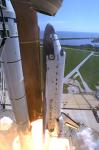 Atlantis to Orbit
13.09.2006
Birds don't fly this high. Airplanes don't go this fast. The Statue of Liberty weighs less. No species other than human can even comprehend what is going on, nor could any human just a millennium ago. The launch of a rocket bound for space is an event that inspires awe and challenges description.
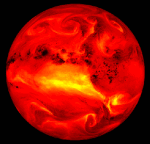 The Water Vapor Channel
9.05.1998
What alien planet's bizarre landscape lurks below these fiery-looking clouds? It's only Planet Earth, of course ... as seen on the Water Vapor Channel. Hourly, images like this one (an infrared image shown in false color) are brought to you by the orbiting Geostationary Operational Environmental Satellites' (GOES) multi-channel imagers.
|
January February March April May June July August |
||||||||||||||||||||||||||||||||||||||||||||||||||||||||