
|
You entered: Earth
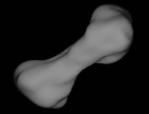 Dog-Bone Shaped Asteroid 216 Kleopatra
10.05.2000
An asteroid the size of New Jersey that orbits the Sun between Mars and Jupiter has been discovered to have an unusual dog-bone shape. Asteroid 216 Kleopatra, recently mapped with Earth-based radar, reflects radio waves so well that astronomers speculate it is composed mostly of metals such as nickel and iron.
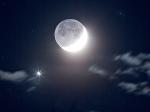 Venus Near the Moon
23.05.2007
The two brightest objects in the night sky appeared to go right past each other last week. On the night of May 19, Earth's Moon and the planet Venus were visible in the same part of the sky, and at closest approach were less than one degree apart.
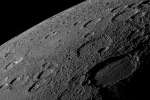 Mercurys Horizon from MESSENGER
21.01.2008
What would it look like to fly past Mercury? Just such an adventure was experienced last week by the MESSENGER spacecraft during its first flyby of the strange moon-like world nearest the Sun. Pictured above is the limb of Mercury seen by MESSENGER upon approach, from about 1 1/2 Earth diameters away.
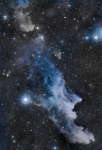 The Witch Head Nebula
30.10.2015
Double, double toil and trouble; Fire burn, and cauldron bubble .... maybe Macbeth should have consulted the Witch Head Nebula. A suggestively shaped reflection nebula, this cosmic crone is about 800 light-years away though. Its frightening visage seems to glare toward nearby bright star Rigel in Orion, just off the right edge of this frame.
 Leonids Over Monument Valley
15.11.2015
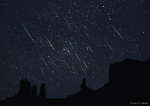
There was a shower over Monument Valley -- but not water. Meteors. The featured image -- actually a composite of six exposures of about 30 seconds each -- was taken in 2001, a year when there was a very active Leonids shower.
 Luminous Salar de Uyuni
15.04.2017
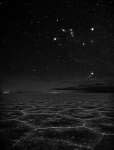
A scene in high contrast this thoughtful night skyscape is a modern composition inspired by M. C. Escher's lithograph Phosphorescent Sea. In it, bright familiar stars of Orion the Hunter and Aldebaran, eye of Taurus the Bull, hang in clear dark skies above a distant horizon.
 Selfie at Vera Rubin Ridge
26.01.2018
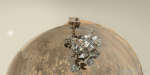
On sol 1943 of its journey of exploration across the surface of Mars, the Curiosity Rover recorded this selfie at the south rim of Vera Rubin Ridge. Of course a sol is a Martian solar day, about 40 minutes longer than an Earth day. Curiosity's sol 1943 corresponds to Earth date January 23, 2018.
 Tau Herculids from Space
4.06.2022
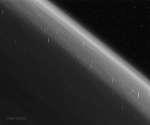
On May 31 tens of parallel meteor streaks were recorded in this 8 degree wide field of view of planet Earth's limb from space. The image is one of a series of 5 minute long observations by the orbiting Yangwang-1 space telescope.
 Interstellar Voyager
9.09.2022
Voyager 1 and Voyager 2 were launched in 1977 on a grand tour of the outer planets of the Solar System. They have become the longest operating and most distant spacecraft from Earth. Both have traveled beyond the heliosphere, the realm defined by the influence of the solar wind and the Sun's magnetic field.
 IC 2118: The Witch Head Nebula
27.12.2005
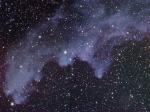
Double, double toil and trouble; Fire burn, and cauldron bubble -- maybe Macbeth should have consulted the Witch Head Nebula. This suggestively shaped reflection nebula is associated with the bright star Rigel in the constellation Orion.
|
January February March April May June July August September October |
|||||||||||||||||||||||||||||||||||||||||||||||||