
|
You entered: nearest stars
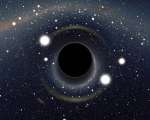 Too Close to a Black Hole
26.10.2014
What would you see if you went right up to a black hole? Featured is a computer generated image highlighting how strange things would look. The black hole has such strong gravity that light is noticeably bent towards it - causing some very unusual visual distortions.
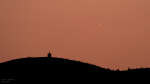 The Last Days of Venus as the Evening Star
5.10.2018
That's not a young crescent Moon poised above the hills along the western horizon at sunset. It's Venus in a crescent phase. About 54 million kilometers away and less than 20 percent illuminated, it was captured by telescope and camera on September 30 near Bacau, Romania.
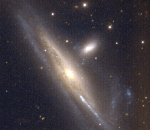 Interacting Galaxies
10.07.1998
This dramatic image of an interacting pair of galaxies was made using the 1.5 meter telescope at the Cerro Tololo Inter-American Observatory near La Serena, Chile. NGC 1531 is the background galaxy with a bright core just above center and NGC 1532 is the foreground spiral galaxy laced with dust lanes.
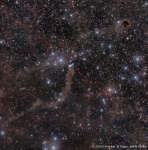 In Wolf s Cave
7.09.2019
The mysterious blue reflection nebula found in catalogs as VdB 152 or Ced 201 really is very faint. It lies at the tip of the long dark nebula Barnard 175 in a dusty complex that has also been called Wolf's Cave.
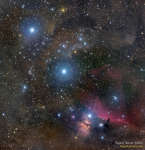 Alnitak, Alnilam, Mintaka
12.12.2013
Alnitak, Alnilam, and Mintaka, are the bright bluish stars from east to west (lower right to upper left) along the diagonal in this gorgeous cosmic vista. Otherwise known as the Belt of Orion, these three blue supergiant stars are hotter and much more massive than the Sun.
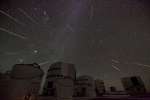 When Gemini Sends Stars to Paranal
15.12.2012
From a radiant point in the constellation of the Twins, the annual Geminid meteor shower rained down on planet Earth this week. Recorded near the shower's peak in the early hours of December...
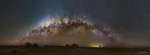 The Milky Way Sets
26.08.2016
Under dark skies the setting of the Milky Way can be a dramatic sight. Stretching nearly parallel to the horizon, this rich, edge-on vista of our galaxy above the dusty Namibian desert stretches from bright, southern Centaurus (left) to Cepheus in the north (right).
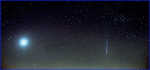 Comet Hyakutake on a Starry Night
23.04.1996
It was a starry night in April (April 9th, 1996, 9:32 pm CDT to be exact) near Lone Jack, Missouri when Comet Hyakutake graced this astronomically rich field. Making an appearance as the brilliant evening star, Venus is overexposed at the far left.
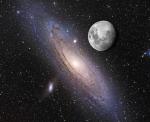 Moon Over Andromeda
28.12.2006
The Great Spiral Galaxy in Andromeda (aka M31), a mere 2.5 million light-years distant, is the closest large spiral to our own Milky Way. Andromeda is visible to the unaided eye as a small...
 Mars in a Manger
30.04.2010
At opposition in late January, Mars shone very brightly in planet Earth's night sky, among the stars of the constellation Cancer the Crab. Since then the Red Planet has been fading, but still lingers in Cancer during April and May.
|
January February March April May June July August September October |
|||||||||||||||||||||||||||||||||||||||||||||||||