
|
You entered: Observatory
 Hubble's Constant And The Expanding Universe (I)
13.05.1996
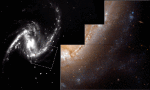
Our Universe is expanding. Distant galaxies appear to recede from us at ever-increasing speeds. What is the rate of expansion? How long has it been expanding? What will be its ultimate fate? Two groups of astronomers are searching vigorously for answers to these fundamental questions using the Hubble Space Telescope (HST).
 Comet Hyakutake Passes the Earth
25.03.1996
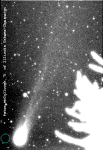
This picture of Comet Hyakutake taken the night of March 21/22 in Illinois, USA shows the enormous tail that has already developed. The silhouette on the right is a foreground tree, and the superposed green circle on the left shows the size of the full moon.
 Giant Galaxy NGC 6872
3.04.2011
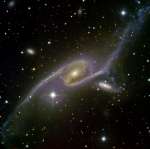
Over 400,000 light years across NGC 6872 is an enormous spiral galaxy, at least 4 times the size of our own, very large, Milky Way. About 200 million light-years distant, toward the southern...
 Symbiotic R Aquarii
5.02.2022
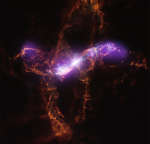
Variable star R Aquarii is actually an interacting binary star system, two stars that seem to have a close symbiotic relationship. Centered in this space-based optical/x-ray composite image it lies about 710 light years away.
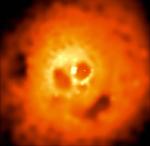 The Perseus Cluster s X Ray Skull
31.10.2000
This haunting image from the orbiting Chandra Observatory reveals the Perseus Cluster of Galaxies in x-rays, photons with a thousand or more times the energy of visible light. Three hundred twenty million light-years distant, the Perseus Cluster contains thousands of galaxies, but none of them are seen here.
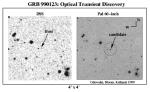 Galaxy And Gamma Ray Burst
25.01.1999
Gamma-ray bursts rule the high-energy sky and Saturday another brief, intense flash of gamma-rays from the cosmos triggered space-based detectors. The orbiting Compton Observatory's BATSE instrument quickly relayed the burst's approximate location to fast-slewing, ground-based cameras primed to search for an elusive optical flash.
 An Active Sun During a Total Eclipse
11.11.2013
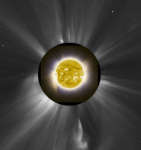
Sometimes, a total eclipse of the Sun is an opportunity. Taking advantage of such, the above image shows the solar eclipse earlier this month as covered and uncovered by several different solar observatories.
 X rays from Supernova Remnant SN 1006
23.04.2013
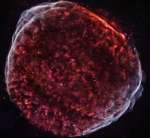
What looks like a puff-ball is surely the remains of the brightest supernova in recorded human history. In 1006 AD, it was recorded as lighting up the nighttime skies above areas now known as China, Egypt, Iraq, Italy, Japan, and Switzerland.
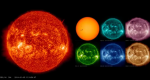 The Sun Rotating
12.03.2014
Does the Sun change as it rotates? Yes, and the changes can vary from subtle to dramatic. In the above time-lapse sequences, our Sun -- as imaged by NASA's Solar Dynamics Observatory -- is shown rotating though the entire month of January.
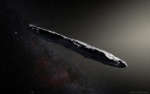 APOD: 2017 November 22 Oumuamua: Interstellar Asteroid
22.11.2017
Nothing like it has ever been seen before. The unusual space rock 'Oumuamua is so intriguing mainly because it is the first asteroid ever detected from outside our Solar System -- although likely many more are to follow given modern computer-driven sky monitoring.
|
January February March April May June July August September October |
|||||||||||||||||||||||||||||||||||||||||||||||||