
|
You entered: cluster
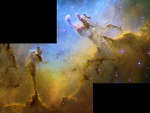 The Eagle Nebula in Hydrogen Oxygen, and Silicon
27.02.2008
Bright blue stars are still forming in the dark pillars of the Eagle Nebula. Made famous by a picture from the Hubble Space Telescope in 1995, the Eagle Nebula shows the dramatic process of star formation.
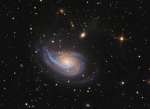 Arp 78: Peculiar Galaxy in Aries
7.07.2011
Peculiar spiral galaxy Arp 78 is found within the boundaries of the head strong constellation Aries, some 100 million light-years beyond the stars and nebulae of our Milky Way galaxy. Also known...
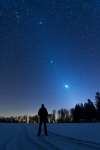 A Zodiacal Skyscape
23.02.2012
Venus and Jupiter are this month's two brightest planets. Shortly after sunset on February 20, they dominate the sky above the western horizon and this snowy landscape. In clear and transparent skies over Cherry Springs State Park, Pennsylvania, USA, they are also seen immersed in Zodiacal light.
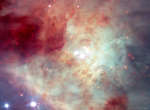 Fast Stars and Rogue Planets in the Orion Nebula
21.03.2017
Start with the constellation of Orion. Below Orion's belt is a fuzzy area known as the Great Nebula of Orion. In this nebula is a bright star cluster known as the Trapezium, marked by four bright stars near the image center.
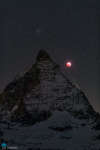 Matterhorn, Moon, and Meteor
24.01.2019
Fans of planet Earth probably recognize the Matterhorn in the foreground of this night skyscape. Famed in mountaineering history, the 4,478 meter Alpine mountain stands next to the totally eclipsed Moon. In spite...
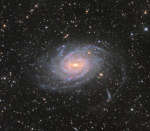 Spiral Galaxy NGC 6744
5.12.2019
Beautiful spiral galaxy NGC 6744 is nearly 175,000 light-years across, larger than our own Milky Way. It lies some 30 million light-years distant in the southern constellation Pavo and appears as only a faint, extended object in small telescopes.
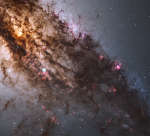 Central Centaurus A
22.02.2020
A mere 11 million light-years away, Centaurus A is the closest active galaxy to planet Earth. Also known as NGC 5128, the peculiar elliptical galaxy is over 60,000 light-years across. A region spanning about 8,500 light-years, including the galaxy's center (upper left), is framed in this sharp Hubble Space telescope close-up.
 Orionids in Taurus
26.10.2023
History's first known periodic comet, Comet Halley (1P/Halley), returns to the inner Solar System every 76 years or so. The famous comet made its last appearance to the naked-eye in 1986. But dusty...
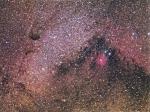 M24: A Sagittarius Starscape
21.09.2004
Many vast star fields in the plane of our Milky Way Galaxy are rich in clouds of dust, and gas. First and foremost, visible in the above picture are millions of stars, many of which are similar to our Sun.
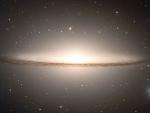 The Sombrero Galaxy from VLT
28.02.2000
Why does the Sombrero Galaxy look like a hat? Reasons include the Sombrero's unusually large and extended central bulge of stars, and dark prominent dust lanes that appear in a disk that we see nearly edge-on. Billions of old stars cause the diffuse glow of the extended central bulge.
|
January February March April May June July August September October |
|||||||||||||||||||||||||||||||||||||||||||||||||