
|
You entered: clouds
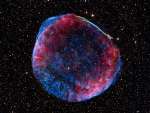 SN 1006 Supernova Remnant
4.07.2008
A new star, likely the brightest supernova in recorded human history, lit up planet Earth's sky in the year 1006 AD. The expanding debris cloud from the stellar explosion, found in the southerly constellation of Lupus, still puts on a cosmic light show across the electromagnetic spectrum.
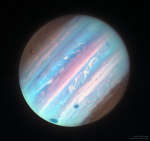 Jupiter in Ultraviolet from Hubble
16.10.2018
Jupiter looks a bit different in ultraviolet light. To better interpret Jupiter's cloud motions and to help NASA's robotic Juno spacecraft understand the planetary context of the small fields that it sees, the Hubble Space Telescope is being directed to regularly image the entire Jovian giant.
 Treble Clef: Unusual X-ray Hot Radio Source
19.10.2026
What is Treble Clef? This unusual radio structure extends over 2 million light-years and resembles a common musical symbol -- but has its visible light hidden by our own Milky Way Galaxy. Examined in 2004, the nature of VLSS J0318.9+5755, dubbed Treble Clef, remained unknown.
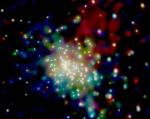 X Ray Mystery in RCW 38
27.12.2002
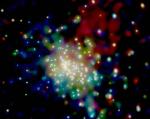
A mere 6,000 light-years distant and sailing through the constellation Vela, star cluster RCW 38 is full of powerful stars. It's no surprise that these stars, only a million years young with hot outer atmospheres, appear as point-like x-ray sources dotting this x-ray image from the orbiting Chandra Observatory.
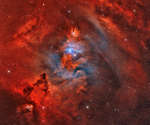 A Fox Fur, a Unicorn, and a Christmas Tree
10.04.2012
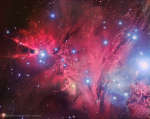
What do the following things have in common: a cone, the fur of a fox, and a Christmas tree? Answer: they all occur in the constellation of the unicorn (Monoceros). Pictured above...
 A Fox Fur, a Unicorn, and a Christmas Tree
4.01.2015
What do the following things have in common: a cone, the fur of a fox, and a Christmas tree? Answer: they all occur in the constellation of the unicorn (Monoceros). Pictured as a star...
 Supernova Remnant Cassiopeia A
17.01.2025
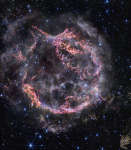
Massive stars in our Milky Way Galaxy live spectacular lives. Collapsing from vast cosmic clouds, their nuclear furnaces ignite and create heavy elements in their cores. After only a few million years for the most massive stars, the enriched material is blasted back into interstellar space where star formation can begin anew.
 X Ray Mystery in RCW 38
8.01.2005
A mere 6,000 light-years distant and sailing through the constellation Vela, star cluster RCW 38 is full of powerful stars. It's no surprise that these stars, only a million years young with hot outer atmospheres, appear as point-like x-ray sources dotting this x-ray image from the orbiting Chandra Observatory.
 The Tarantula Zone
13.11.2020
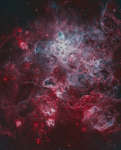
The Tarantula Nebula, also known as 30 Doradus, is more than a thousand light-years in diameter, a giant star forming region within nearby satellite galaxy the Large Magellanic Cloud. About 180 thousand light-years away, it's the largest, most violent star forming region known in the whole Local Group of galaxies.
 Supernova Remnant Cassiopeia A
6.02.2026
Massive stars in our Milky Way Galaxy live spectacular lives. Collapsing from vast cosmic clouds, their nuclear furnaces ignite and create heavy elements in their cores. After only a few million years for the most massive stars, the enriched material is blasted back into interstellar space where star formation can begin anew.
|
January February March April May June July August September October November |
||||||||||||||||||||||||||||||||||||||||||||||||||||||||