
|
You entered: Earth orbit
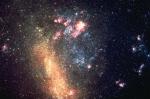 Neighboring Galaxy: The Large Magellanic Cloud
4.08.2001
The brightest galaxy visible from our own Milky Way Galaxy is the Large Magellanic Cloud (LMC). Visible predominantly from Earth's Southern Hemisphere, the LMC is the second closest galaxy, neighbor to the Small Magellanic Cloud, and one of eleven known dwarf galaxies that orbit our Milky Way Galaxy.
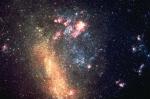 Neighboring Galaxy: The Large Magellanic Cloud
22.02.2000
The brightest galaxy visible from our own Milky Way Galaxy is the Large Magellanic Cloud (LMC). Visible predominantly from Earth's Southern Hemisphere, the LMC is the second closest galaxy, neighbor to the Small Magellanic Cloud, and one of eleven known dwarf galaxies that orbit our Milky Way Galaxy.
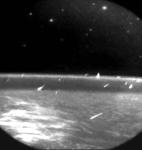 Leonids from Orbit
29.11.2000
Here is what a meteor shower looks like from orbit. During the peak of the 1997 Leonid Meteor Shower, the MSX satellite imaged from above 29 meteors over a 48 minute period entering the Earth's atmosphere. From above, meteors create short bright streaks.
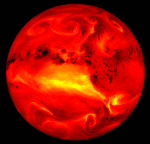 The Water Vapor Channel
12.10.1996
What alien planet's bizarre landscape lurks below these fiery-looking clouds? It's only Planet Earth, of course -- as seen on the Water Vapor Channel. Hourly, images like this one (shown in false color) are brought to you by the orbiting GOES 8 satellite's multi-channel imager.
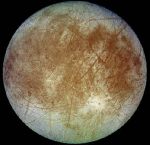 Europa Full Face
20.11.1996
What mysteries might be solved by peering into this crystal ball? This crystal ball is quite unusual because it is actually a moon of Jupiter, the crystals are ice-crystals, and the ball is not only dirty and opaque but cracked beyond repair.
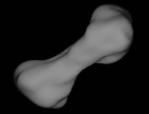 Dog-Bone Shaped Asteroid 216 Kleopatra
10.05.2000
An asteroid the size of New Jersey that orbits the Sun between Mars and Jupiter has been discovered to have an unusual dog-bone shape. Asteroid 216 Kleopatra, recently mapped with Earth-based radar, reflects radio waves so well that astronomers speculate it is composed mostly of metals such as nickel and iron.
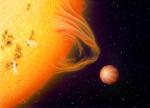 Upsilon Andromedae: An Extra Solar System
16.04.1999
Yesterday, astronomers announced the discovery of the first system of planets around a normal star other than our Sun. Previously, only single planet star systems had been found. Subtle changes in the wobble of Upsilon Andromedae, a Sun-like star in the constellation of Andromeda, allowed astronomers led by R. Paul Butler (AAO) and Geoffrey W.
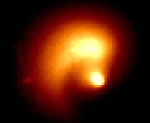 Comet Hale-Bopp Update
30.10.1995
Will comet Hale-Bopp become the brightest comet of the Century in early 1997? Since its discovery in July this year, Hale-Bopp has caused much speculation. Even though it is still beyond the orbit of Jupiter it is astonishingly bright and expected to get much brighter as it plunges inward, toward the Sun.
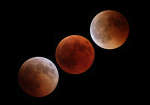 Central Lunar Eclipse
3.08.2018
Reddened by scattered sunlight, the Moon in the center is passing through the center of Earth's dark umbral shadow in this July 27 lunar eclipse sequence. Left to right the three images are from the start, maximum, and end to 103 minutes of totality from the longest lunar eclipse of the 21st century.
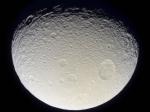 Saturns Moon Tethys from Cassini
29.11.2004
Tethys is one of the larger and closer moons of Saturn. The Cassini spacecraft now orbiting Saturn passed near the frozen moon at the end of October, capturing the most detailed images since the Voyager spacecrafts in the early 1980s.
|
January February March April May June July August |
||||||||||||||||||||||||||||||||||||||||||||||||||||||||