
|
You entered: Earth's moon
 NGC 6995: The Bat Nebula
27.10.2021
Do you see the bat? It haunts this cosmic close-up of the eastern Veil Nebula. The Veil Nebula itself is a large supernova remnant, the expanding debris cloud from the death explosion of a massive star.
 APOD: 2024 September 4 Б NGC 6995: The Bat Nebula
4.09.2024
Can you see the bat? It haunts this cosmic close-up of the eastern Veil Nebula. The Veil Nebula itself is a large supernova remnant, the expanding debris cloud from the death explosion of a massive star.
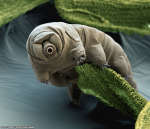 Tardigrade in Moss
26.03.2017
Is this an alien? Probably not, but of all the animals on Earth, the tardigrade might be the best candidate. That's because tardigrades are known to be able to go for decades without...
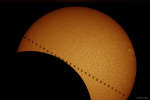 A Fleeting Double Eclipse of the Sun
28.08.2017
Last week, for a fraction of a second, the Sun was eclipsed twice. One week ago today, many people in North America were treated to a standard, single, partial solar eclipse. Fewer people, all congregated along a narrow path, experienced the eerie daytime darkness of a total solar eclipse.
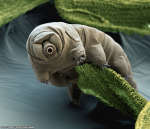 Tardigrade in Moss
6.03.2013
Is this an alien? Probably not, but of all the animals on Earth, the tardigrade might be the best candidate. That's because tardigrades are known to be able to go for decades without...
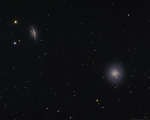 Cetus Galaxies and Supernova
6.12.2018
Large spiral galaxy NGC 1055 at top left joins spiral Messier 77 (bottom right) in this cosmic view toward the aquatic constellation Cetus. The narrowed, dusty appearance of edge-on spiral NGC 1055 contrasts nicely with the face-on view of M77's bright nucleus and spiral arms.
 Full Moons of August
30.08.2023
Near perigee, the closest point in its almost moonthly orbit, a Full Moon rose as the Sun set on August 1. Its brighter than average lunar disk was captured in this dramatic moonrise sequence over dense cloud banks along the eastern horizon from Ragusa, Sicily.
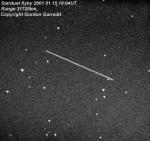 Sail On Stardust
25.01.2001
Spacecraft on long interplanetary voyages often use the planets themselves as gravitational "sling shots" to boost them along their way. Launched in February of 1999 on a historic voyage to a comet, the Stardust spacecraft is no different.
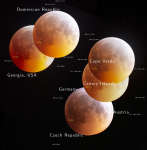 Lunar Eclipse Perspectives
5.02.2020
Do we all see the same Moon? Yes, but we all see it differently. One difference is the apparent location of the Moon against background stars -- an effect known as parallax. We humans use the parallax between our eyes to judge depth.
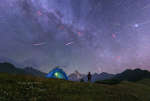 Meteors over Four Girl Mountains
13.12.2016
On some nights it rains meteors. Peaking over the next two nights, asteroid dust is expected to rain down on Earth during the annual Geminids meteor shower. This year, unfortunately, fainter Geminids will be harder to see because of the brightness of the Long Nights Full Moon, which occurs Wednesday.
|
January February March April May June July August September |
|||||||||||||||||||||||||||||||||||||||||||||||||