
|
You entered: nebula
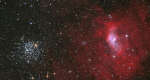 The Bubble and the Star Cluster
25.09.2021
To the eye, this cosmic composition nicely balances the Bubble Nebula at the right with open star cluster M52. The pair would be lopsided on other scales, though. Embedded in a complex of interstellar...
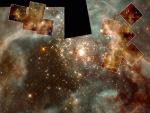 Massive Stars of 30 Doradus
22.06.2003
In the center of star-forming region 30 Doradus lies a huge cluster of the largest, hottest, most massive stars known. These stars and part of the surrounding nebula are captured here in this gorgeous visible-light Hubble Space Telescope image.
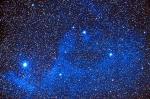 Starlight Reflections
14.04.1998
Wisps of dust fill the space between the stars. This dust is usually invisible, subtly acting to dim the light of more distant stars. Sometimes this dust is thick and prominent as dark patches on otherwise bright emission nebulae. Other times this dust may show itself by reflecting the light of bright, nearby stars.
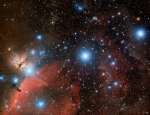 Alnitak, Alnilam, Mintaka
21.01.2011
Alnitak, Alnilam, and Mintaka, are the bright bluish stars from east to west (left to right) along the diagonal in this gorgeous cosmic vista. Otherwise known as the Belt of Orion, these three blue supergiant stars are hotter and much more massive than the Sun.
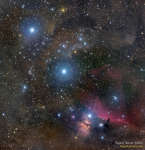 Alnitak, Alnilam, Mintaka
12.12.2013
Alnitak, Alnilam, and Mintaka, are the bright bluish stars from east to west (lower right to upper left) along the diagonal in this gorgeous cosmic vista. Otherwise known as the Belt of Orion, these three blue supergiant stars are hotter and much more massive than the Sun.
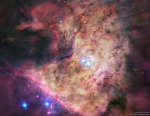 Trapezium: At the Heart of Orion
5.08.2018
Near the center of this sharp cosmic portrait, at the heart of the Orion Nebula, are four hot, massive stars known as the Trapezium. Gathered within a region about 1.5 light-years in radius, they dominate the core of the dense Orion Nebula Star Cluster.
 APOD: 2025 March 5 Б Seven Sisters versus California
5.03.2025
On the right, dressed in blue, is the Pleiades. Also known as the Seven Sisters and M45, the Pleiades is one of the brightest and most easily visible open clusters on the sky. The Pleiades contains over 3,000 stars, is about 400 light years away, and only 13 light years across.
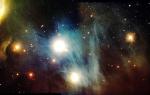 A Chamaeleon Sky
23.03.1999
A photogenic group of nebulae can be found in Chamaeleon, a constellation visible predominantly in skies south of the Earth's equator. Towards Chamaeleon, dark molecular clouds and bright planetary nebula NGC 3195 can be found. Visible near the center of the above photograph is a reflection nebula surrounding a young bright star.
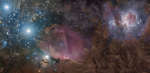 Orion in Gas, Dust, and Stars
29.09.2009
The constellation of Orion holds much more than three stars in a row. A deep exposure shows everything from dark nebula to star clusters, all imbedded in an extended patch of gaseous wisps in the greater Orion Molecular Cloud Complex.
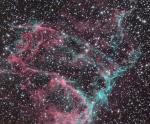 IC1340 in the Eastern Veil
26.09.2003
These ghostly filaments of interstellar gas are just a small part of the expansive Veil Nebula, seen against a rich field of background stars in the long-necked constellation Cygnus. Also known as the Cygnus...
|
January February March April May |
|||||||||||||||||||||||||||||||||||||||||||||||||