
|
You entered: star formation
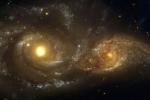 Spiral Galaxies in Collision
9.11.1999
Billions of years from now, only one of these two galaxies will remain. Until then, spiral galaxies NGC 2207 and IC 2163 will slowly pull each other apart, creating tides of matter, sheets of shocked gas, lanes of dark dust, bursts of star formation, and streams of cast-away stars.
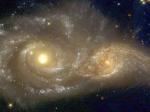 Spiral Galaxies in Collision
21.11.2004
Billions of years from now, only one of these two galaxies will remain. Until then, spiral galaxies NGC 2207 and IC 2163 will slowly pull each other apart, creating tides of matter, sheets of shocked gas, lanes of dark dust, bursts of star formation, and streams of cast-away stars.
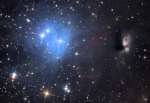 Reflection Nebula vdB1
26.10.2012
Every book has a first page and every catalog a first entry. And so this lovely blue cosmic cloud begins the van den Bergh Catalog (vdB) of stars surrounded by reflection nebulae. Interstellar dust...
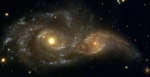 Spiral Galaxies in Collision
19.01.2014
Billions of years from now, only one of these two galaxies will remain. Until then, spiral galaxies NGC 2207 and IC 2163 will slowly pull each other apart, creating tides of matter, sheets of shocked gas, lanes of dark dust, bursts of star formation, and streams of cast-away stars.
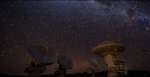 An ALMA Telescope Array Time Lapse
26.05.2014
It is the most expensive and complex ground-based astronomy project ever -- what will it see tonight? The Atacama Large Millimeter Array (ALMA) project consists of 66 dishes, many the size of a small house, situated in the high altitude Atacama Desert in Northern Chile.
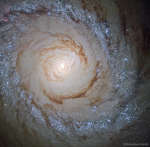 Starburst Galaxy M94 from Hubble
1.12.2019
Why does this galaxy have a ring of bright blue stars? Beautiful island universe Messier 94 lies a mere 15 million light-years distant in the northern constellation of the Hunting Dogs (Canes Venatici).
 APOD: 2025 January 6 Б Colliding Spiral Galaxies from Webb and Hubble
6.01.2025
Billions of years from now, only one of these two galaxies will remain. Until then, spiral galaxies NGC 2207 and IC 2163 will slowly pull each other apart, creating tides of matter, sheets of shocked gas, lanes of dark dust, bursts of star formation, and streams of cast-away stars.
 Along the Taurus Molecular Cloud
23.11.2023
The cosmic brush of star formation composed this interstellar canvas of emission, dust, and dark nebulae. A 5 degree wide telescopic mosaic, it frames a region found north of bright star Aldebaran on the sky, at an inner wall of the local bubble along the Taurus molecular cloud.
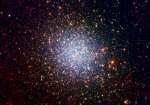 The Giants of Omega Centauri
1.05.2008
Globular star cluster Omega Centauri is some 15,000 light-years away and 150 light-years in diameter. Packed with about 10 million stars, Omega Cen is the largest of 200 or so known globular clusters that roam the halo of our Milky Way galaxy.
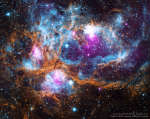 NGC 6357: Stellar Wonderland
26.12.2016
For reasons unknown, NGC 6357 is forming some of the most massive stars ever discovered. This complex wonderland of star formation consists of numerous filaments of dust and gas surrounding huge cavities of massive star clusters. The intricate patterns are caused by complex interactions between interstellar winds, radiation pressures, magnetic fields, and gravity.
|
January February March April May June July August September October |
|||||||||||||||||||||||||||||||||||||||||||||||||