
|
You entered: rocks
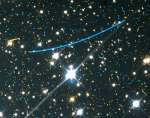 Asteroids in the Distance
10.02.2013
Rocks from space hit Earth every day. The larger the rock, though, the less often Earth is struck. Many kilograms of space dust pitter to Earth daily. Larger bits appear initially as a bright meteor. Baseball-sized rocks and ice-balls streak through our atmosphere daily, most evaporating quickly to nothing.
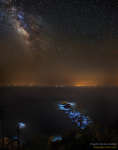 Blue Tears and the Milky Way
24.04.2015
Lapping at rocks along the shore of the Island of Nangan, Taiwan, planet Earth, waves are infused with a subtle blue light in this sea and night skyscape. Composed of a series of long exposures made on April 16 the image captures the faint glow from Noctiluca scintillans.
 APOD: 2025 July 23 Б Fireball over Cape San Blas
23.07.2025
Have you ever seen a fireball? In astronomy, a fireball is a very bright meteor -- one at least as bright as Venus and possibly brighter than even a full Moon. Fireballs are rare -- if you see one you are likely to remember it for your whole life.
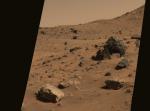 Strangers on Mars
21.07.2006
This view from the winter station of Mars Exploration Rover Spirit, looks across the rock strewn landscape of Gusev Crater. The dark boulders and distant hills are characteristic of the region...
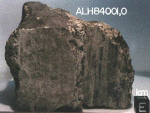 A Meteorite From Mars
17.08.1996
The famous Martian meteorite pictured above houses microscopic structures interpreted by many as fossils of ancient Martian life. How do you find a meteorite from Mars here on Earth? On a typical day, several large rocks fall to Earth from space, usually winding up in the oceans.
 APOD: 2011 December 11 Searching for Meteorites in Antarctica
11.12.2011
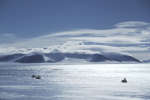
Where is the best place on Earth to find meteorites? Although meteors fall all over the world, they usually just sink to the bottom of an ocean, are buried by shifting terrain, or are easily confused with terrestrial rocks.
 Hoodoo Sky
3.07.2008
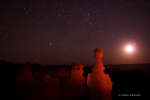
The strange-looking rock formations in the foreground of this skyscape are called hoodoos. Towers of weathered, eroded sedimentary rock, hoodoos are found in arid regions of planet Earth and are particularly abundant in an area known as Bryce Canyon National Park in southern Utah, USA.
 Asteroids in the Distance
23.06.2002
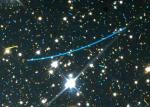
Rocks from space hit Earth every day. The larger the rock, though, the less often Earth is struck. Many kilograms of space dust pitter to Earth daily. Larger bits appear initially as a bright meteor. Baseball-sized rocks and ice-balls streak through our atmosphere daily, most evaporating quickly to nothing.
 Asteroids in the Distance
17.04.2005
Rocks from space hit Earth every day. The larger the rock, though, the less often Earth is struck. Many kilograms of space dust pitter to Earth daily. Larger bits appear initially as a bright meteor. Baseball-sized rocks and ice-balls streak through our atmosphere daily, most evaporating quickly to nothing.
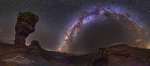 Milky Way and Stone Tree
29.04.2013
What's that next to the Milky Way? An unusual natural rock formation known as Roque Cinchado or Stone Tree found on the Spanish Canary Island of Tenerife. A famous icon, Roque Cinchado is likely a dense plug of cooled volcanic magma that remains after softer surrounding rock eroded away.
|
January February March April May June July August September |
|||||||||||||||||||||||||||||||||||||||||||||||||