
|
You entered: red dwarf
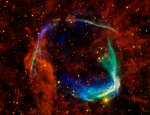 RCW 86: Historical Supernova Remnant
10.11.2011
In 185 AD, Chinese astronomers recorded the appearance of a new star in the Nanmen asterism - a part of the sky identified with Alpha and Beta Centauri on modern star charts. The new star was visible for months and is thought to be the earliest recorded supernova.
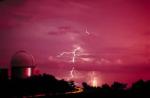 Telescope with Lightning
19.01.1999
Telescopes are not very useful during lightning storms. Nevertheless, with lightning illuminating a dark landscape, the picturesque dome of the famous Kitt Peak 2.1-meter Telescope makes for a dramatic photograph. A passing car created the red and yellow streaks visible in the foreground.
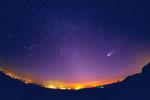 Sirius: The Brightest Star in the Night
11.06.2000
Sirius is the brightest star in the night sky. Sirius is visible on the far left of the above photograph, to the left of the constellation of Orion and Comet Hale-Bopp. Intrinsically, Sirius is over 20 times brighter than our Sun and over twice as massive.
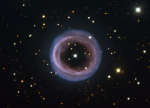 Shapley 1: An Annular Planetary Nebula
16.08.2011
What happens when a star runs out of nuclear fuel? For stars about the mass of our Sun, the center condenses into a white dwarf while the outer atmospheric layers are expelled into space and appear as a planetary nebula.
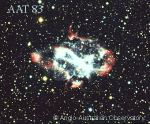 NGC 5189: A Strange Planetary Nebula
11.12.1995
After a Sun-like star can no longer support fusion in its core, the center condenses into a white dwarf while the outer atmospheric layers are expelled into space and appear as a planetary nebula. This particular planetary nebula has a quite strange and chaotic structure.
 APOD: 2023 May 30 Б M27: The Dumbbell Nebula
30.05.2023
Is this what will become of our Sun? Quite possibly. The first hint of our Sun's future was discovered inadvertently in 1764. At that time, Charles Messier was compiling a list of diffuse objects not to be confused with comets.
 APOD: 2024 December 30 Б M27: The Dumbbell Nebula
30.12.2024
Is this what will become of our Sun? Quite possibly. The first hint of our Sun's future was discovered inadvertently in 1764. At that time, Charles Messier was compiling a list of diffuse objects not to be confused with comets.
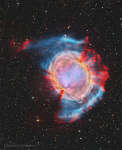 APOD: 2026 June 22 Б M27: The Dumbbell Nebula
22.06.2026
Is this what will become of our Sun? Quite possibly. The first hint of our Sun's future was discovered inadvertently in 1764. At that time, Charles Messier was compiling a list of diffuse objects not to be confused with comets.
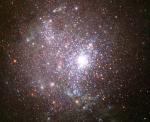 The Stars of NGC 1705
23.04.2003
Some 2,000 light-years across, NGC 1705 is small as galaxies go, similar to our Milky Way's own satellite galaxies, the Magellanic Clouds. At a much larger distance of 17 million light-years...
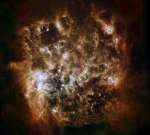 Infrared Portrait of the Large Magellanic Cloud
15.01.2012
Cosmic dust clouds ripple across this infrared portrait of our Milky Way's satellite galaxy, the Large Magellanic Cloud. In fact, the remarkable composite image from the Herschel Space Observatory and the Spitzer Space Telescope show that dust clouds fill this neighboring dwarf galaxy, much like dust along the plane of the Milky Way itself.
|
January February March April May June July August September October |
|||||||||||||||||||||||||||||||||||||||||||||||||