
|
You entered: magnetic field
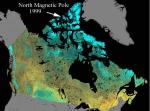 Earths North Magnetic Pole
19.09.2004
A magnetic compass does not point toward the true North Pole of the Earth. Rather, it more closely points toward the North Magnetic Pole of the Earth. The North Magnetic Pole is currently located in northern Canada.
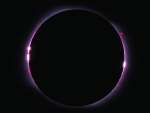 At the Sun s Edge
7.08.2008
A train trip on the Trans-Siberian railway to Novosibirsk resulted in this stunning view along the edge of the Sun recorded during the August 1st total solar eclipse. The picture is a composite...
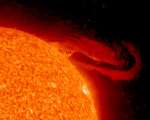 A Solar Prominence Unfurls
4.10.2008
On September 29, this magnificent eruptive solar prominence lifted away from the Sun's surface, unfurling into space over the course of several hours. Suspended in twisted magnetic fields, the hot plasma structure is many times the size of planet Earth and was captured in this view by the Sun-watching STEREO (Ahead) spacecraft.
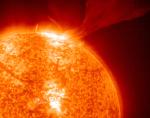 A Solar Prominence Erupts
24.09.2001
Our Sun is still very active. Last year, our Sun went though Solar Maximum, the time in its 11-year cycle where the most sunspots and explosive activities occur. Sunspots, the Solar Cycle, and solar prominences are all caused by the Sun's changing magnetic field.
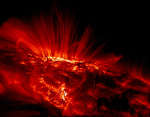 Sunspot Loops in Ultraviolet
10.04.2011
It was a quiet day on the Sun. The above image shows, however, that even during off days the Sun's surface is a busy place. Shown in ultraviolet light, the relatively cool dark regions have temperatures of thousands of degrees Celsius.
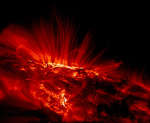 Sunspot Loops in Ultraviolet
26.01.2014
It was a quiet day on the Sun. The above image shows, however, that even during off days the Sun's surface is a busy place. Shown in ultraviolet light, the relatively cool dark regions have temperatures of thousands of degrees Celsius.
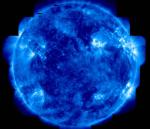 Autumn and the Active Sun
23.09.1998
As the Sun heads South, crossing the celestial equator today at 1:37 a.m. Eastern Time, Autumn begins for Earth's Northern Hemisphere. This Autumnal Equinox finds an increasingly active Sun steadily approaching a solar cycle maximum expected around the year 2003.
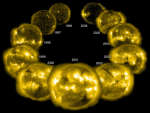 A Complete Solar Cycle from SOHO
2.12.2007
Every eleven years, our Sun goes through a solar cycle. A complete solar cycle has now been imaged by the sun-orbiting SOHO spacecraft, celebrating the 12th anniversary of its launch yesterday. A solar cycle...
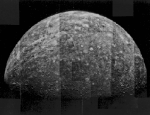 Mercury: Closest Planet to the Sun
14.08.1995
This picture was compiled from images taken by the NASA spacecraft Mariner 10 which flew by the planet three times in 1974. Mercury is the closest planet to the Sun, the second hottest planet (Venus gets hotter), and the second smallest planet (Pluto is smaller).
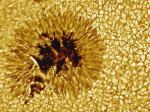 A Sunspot Up Close
5.11.2005
Why would a small part of the Sun appear slightly dark? Visible above is a close-up picture of a sunspot, a depression on the Sun's face that is slightly cooler and less luminous than the rest of the Sun.
|
January February March April May June July August September October |
|||||||||||||||||||||||||||||||||||||||||||||||||